
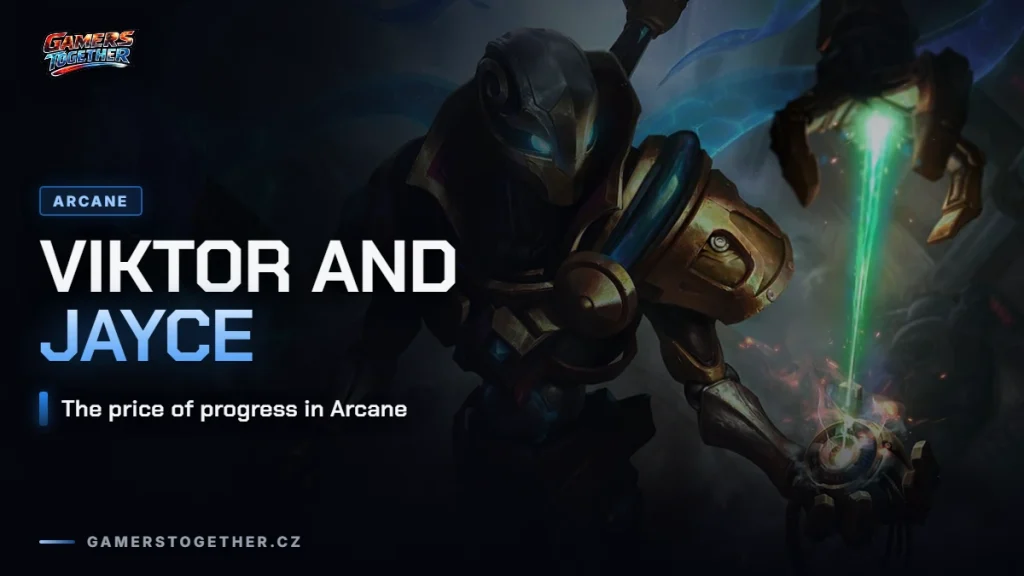
In Arcane, Jayce and Viktor are the two from the lab: the guys who discover hextech together and then watch that discovery tear apart their friendship and their lives. But this duo existed long before the show. Both are playable League of Legends champions, Jayce since 2012 and Viktor since as far back as late 2011. This article shows you how their story is told in the series, what the game already had long before that, and where the two versions part ways, including how the game responded to the ending of Arcane by reworking one of them.
Who Jayce and Viktor are in Arcane
In the series, Jayce Talis is an ambitious inventor from Piltover who craves recognition and gets it, faster and more fully than he expected. Viktor is his quieter, more methodical partner, who came to Piltover from Zaun with a body weakened by illness and a conviction that science can give people what they lack: it can fix them. Together they work on hextech, a technology that stabilizes magical energy enough for anyone to use it, not just mages with an innate gift.
At the start, their relationship works exactly the way a partnership between good friends should. Jayce has the charisma and drive to push the project forward in public, while Viktor has the patience and precision that hold everything together inside the lab. Yet this very imbalance, over who gets the credit and who does the quiet work, is the first crack that splits wide open in later episodes.
Hextech: the discovery that changes both cities
In Arcane, hextech is the discovery that makes it possible to control magical energy through crystals called the arcane hexcore, without the user needing any magical talent of their own. For Piltover, the “City of Progress”, it is exactly the kind of invention the city is built on: the democratization of a power that used to be the privilege of a few. The Piltover Council turns Jayce into a star and eventually one of its members, so the scientist becomes a politician before he is ready for it.
Zaun, however, sees hextech differently. A technology that means progress in Piltover turns, down below, into raw material for drugs, weapons and dangerous body enhancements: chemtech, as Arcane shows it through characters like Sevika or Silco. So hextech doesn’t bring the two cities closer together. It deepens the divide between them: up above it is a symbol of progress, down below a tool for survival in harsher conditions. And this two-sided nature of the invention is exactly why it becomes the core of the whole conflict at the center of Arcane.
You can read more about how Piltover and Zaun are put together and why there’s such a gulf between them in the article on the world of Runeterra and its regions.
The road to the split: why partners become strangers
Jayce and Viktor’s falling-out isn’t a single argument but a slow process that runs through both seasons. Jayce gradually realizes that the hextech he was so proud of can be abused, and his response is to try to control the discovery, regulate it, or even restrict it. Viktor goes in exactly the opposite direction: the more he sees the human body fail (his own because of illness, and other people’s around him), the more radically he believes the answer is to let hextech go even deeper, into the body itself.
This difference in conviction, reform versus radical transformation, is the heart of what the series calls “the price of progress”. Jayce wants progress that people earn and that stays under control. Viktor wants progress that saves people, even if they don’t agree with it themselves. In the second season, Viktor sinks deeper and deeper into his own transformation into a partly mechanical being, which the series calls the Machine Herald, while Jayce tries to find a way to stop something he helped create. The exact moments when their paths finally split are among the key twists of the second season, and we break them down in detail in the season two plot breakdown.
Jayce in the game: the Defender of Tomorrow
In League of Legends, Jayce, officially titled “the Defender of Tomorrow”, is a champion built around the same idea he has in the series: a hextech hammer that can transform into two forms. In hammer form (Mercury Hammer), he is a melee fighter who slows and stuns opponents; after switching to cannon form (Mercury Cannon), he becomes a ranged attacker with slowing and speed-boosting abilities. Switching between the two forms is his core gameplay. You constantly weigh whether you want to be up close or at range, exactly the way an engineer would think about his own invention.
Jayce’s in-game lore describes him the same way the series does: as an inventor who, together with Viktor, made the first major breakthroughs in hextech in League of Legends and became the “Man of Progress”, celebrated all over Piltover, while becoming more and more aware that his invention deepened the divide between Piltover and Zaun. In other words, the game had this conflict in the character’s description long before Arcane expanded it into nineteen episodes of story.
Viktor in the game: from the Machine Herald to the Herald of the Arcane
Until the end of 2024, Viktor was listed in the game under the title “the Machine Herald”: a biomechanical inventor trying to free humanity from suffering by stripping away emotion and replacing it with machinery. His own body was partly mechanical long before the Arcane series even existed. The concept of the “Glorious Evolution”, which Viktor believes in both in Arcane and in the game, had been part of his character for years.
In patch 14.24, released just after the second season of Arcane ended in December 2024, Viktor received a visual and gameplay update (VGU) in League of Legends, and with it a new title: “the Herald of the Arcane”, a direct reference to the series. His abilities moved to a new upgrade system. He collects so-called Hex Fragments from killing enemies and units, using them to gradually upgrade his basic abilities before finally upgrading his ultimate, Arcane Storm (previously known as Chaos Storm). It’s one of the few cases where the game responded this directly to how a series transformed a character. It isn’t just a cosmetic skin but a renaming and rework of the champion itself.
Where the series and game versions differ
The key difference lies in pacing and in what is cause and what is effect. Arcane presents Jayce and Viktor’s transformation as a linear story: first collaboration, then discovery, then fame, then the split and Viktor’s transformation into a half-machine. In the game, by contrast, both characters existed side by side for a long time without a fixed order of events. Viktor had been “the Machine Herald” for more than ten years before Arcane even existed, just without a concrete story explaining how it happened. Arcane filled in that missing piece, and the game responded after the fact by aligning Viktor’s in-game identity with the series version.
The second difference is which of the two is the “main” character. In the series, Jayce and Viktor are practically equal protagonists in the first half of the story, both with the same room to develop. In the game itself, they long worked as two independent champions without a particularly emphasized relationship. Only the lore material and then Arcane turned them into a pair whose friendship and breakup matter as much as their individual abilities.
And third: the series explores a moral question that the game as such doesn’t deal with, because that isn’t its job. You play the game, you watch the series. Jayce’s decisions to regulate hextech and Viktor’s obsession with the “Glorious Evolution” are explored in Arcane as complex character arcs full of doubts, regrets and the price both characters pay. In the game, these motivations stay summed up in a few paragraphs of lore text: enough to make sense, but without the room that nineteen hours of television gives.
The price of progress: why this is the core of the whole story
“The price of progress” isn’t just a nice phrase for a headline. It’s the question Arcane asks through the whole Jayce and Viktor pairing: who has the right to decide what is good for humanity, and how much are they willing to pay for it? Jayce eventually learns that even a well-meant invention can be abused in ways he never wanted, and his answer is to seek control and put on the brakes. Viktor takes the opposite path. He believes that if the goal is good enough (an end to suffering), it justifies even means that an earlier version of himself would have rejected.
This very question, whether progress can be stopped once it starts and who pays its price, is why the Jayce and Viktor duo became one of the strongest threads of the entire series, and why the game responded to their story with a rework of its own. For a complete overview of how they fit in among the other Arcane characters and their playable counterparts, see the article on all the characters in the series and their champions.
FAQ
No. Arcane presents their friendship and falling-out as a standalone story that requires no knowledge of the game. League of Legends players will just notice a few extra details, for example that Viktor’s hammer and Jayce’s weapon share the same visual language in the game as in the series.
Yes, it’s the same character with the same name, profession and connection to hextech. The series simply develops his motivations and relationships in far more depth than a few paragraphs of in-game lore text allow.
Viktor has been in the game since late 2011 and Jayce since mid-2012, so both existed for years before the Arcane series was made.
Arcane deliberately avoids such a simple split. Jayce makes decisions that have bad consequences despite good intentions, and Viktor’s path to the “Glorious Evolution” follows a logic you understand even if you disagree with it. This gray zone is one of the reasons their story works.
Yes. Viktor uses the same technology he and Jayce developed for Piltover; he just turns it on his own body. It’s a direct consequence of the discovery they shared as partners at the start.
Information verified as of 16 August 2026. Viktor’s in-game description and abilities are based on the rework in patch 14.24 from December 2024, which still applies in the current game season. Continue to the season two plot breakdown, the overview of all the characters and their champions, or head back to the League of Legends guide hub.