
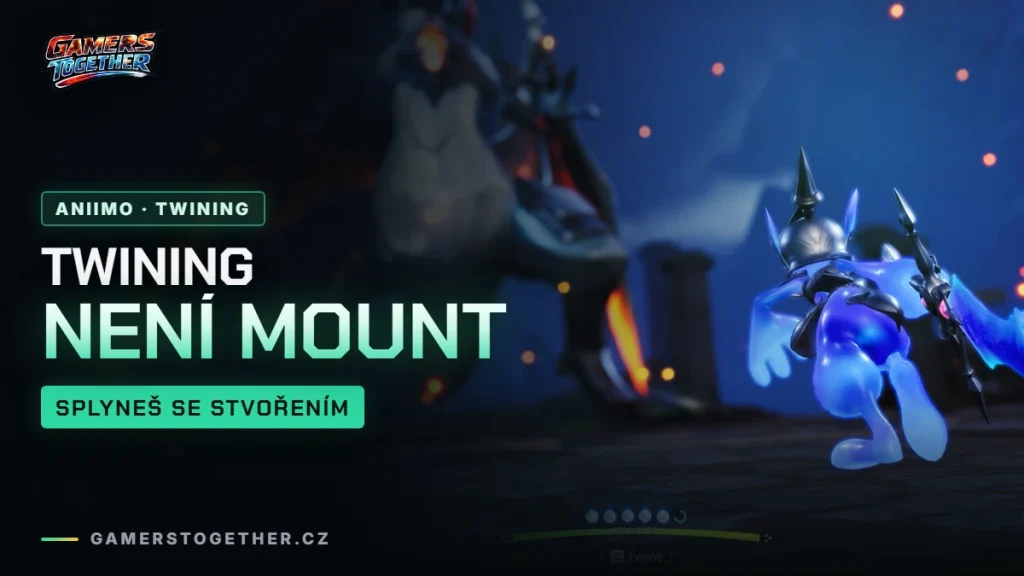
In other games, you ride a creature. In Aniimo, you become one. Twining is the mechanic that lets a player fuse with a caught creature and directly control both its movement and its combat. You don’t just gain a vehicle – for a while, you take over the creature’s way of moving and its attacks. It isn’t riding a mount; it’s swapping your role in the fight entirely, from team commander to one of the team.
- Twining isn’t a mount – it’s a fusion, not a ride
- You take over the creature’s movement and attacks
- Two modes exist: Twine Mode and Command Mode
- Choosing between them is tactical, not cosmetic
What Twining is, and how it differs from a mount
In plenty of games with animal companions, the rule is simple: you climb onto a creature like a vehicle. You’re still controlling your own character; the animal is just a faster way to get from point A to point B. Twining works differently – once activated, you literally fuse with a caught creature and briefly become it.
The difference comes down to three points. A mount carries you; Twining changes you – you’re not steering a rider on a creature, you’re controlling the creature’s body directly. A mount is for transport; Twining is for combat too – you take over its attacks, not just its legs. And where a mount is one thing for the whole game, Twining is as many different experiences as you have caught creatures – each one brings its own movement and its own way of fighting.
| Mount | Twining | |
|---|---|---|
| Movement | you control a rider on the animal | you control the creature’s body directly |
| Combat | the animal typically doesn’t fight on its own | you take over the creature’s attacks |
| Whose stats apply | your character’s | the Twined creature’s, for that moment |
| Variety | one or a handful of mounts for the whole game | a different experience with every creature you catch |
Twine Mode and Command Mode: two ways to fight
Aniimo offers two combat modes, and the difference between them essentially comes down to who you are at that moment. In Command Mode, you stay outside the action and direct the whole team as a unit – deciding who attacks, who defends, who uses a skill. In Twine Mode, you instead become one specific creature and control its movement and strikes directly, while the rest of the team operates around you.
It isn’t a “better or worse” choice – it’s a choice based on the situation. Command Mode gives you an overview of the whole fight at once; Twine Mode gives you precision and immediate control over a single piece. Which one you want depends on whether you need to run overall tactics right now, or execute one specific maneuver exactly.
The precise mechanical details – what the rest of the team does while you’re Twined, or exactly how shared energy behaves in that moment – haven’t been confirmed reliably enough for us to state as fact. We’ll update this once that’s verified; for now we’re sticking to what’s certain: these are two distinct player roles within a single fight, not two separate fights.
How Twining changes combat
Combat in Aniimo runs in real time, not in turns. That means Twining isn’t a menu choice you have time to sit and think over – it’s a decision made mid-motion, timed the same way as a dodge or an attack. Switching into a creature’s role becomes part of the rhythm of the fight, not a pause in it.
The second effect concerns energy. EP is shared across the whole team and shows up as six blue orbs – skills spend it, basic attacks refill it. Whatever you do as a Twined creature happens inside that same shared budget as everything else in the fight, not some separate reserve just for you.
The third effect: your team has four slots and there are five roles. Twining is a way for one of the four present roles to temporarily take over from the rest – for a moment, you’re not directing a system of four pieces, you’re fully being one of them.
One point sources genuinely disagree on, and it’s only fair to admit it: whether Twining has any time or energy limit at all, or whether you can stay Twined indefinitely. The official description of the game doesn’t address this directly, and until it’s confirmed from a reliable source, we’d rather not hand you a made-up number – plan for the possibility of a limit and watch how the creature behaves.
Getting around Idyll: what Twining opens up on the map
Depending on which creature you Twine with, you gain a different way of moving – gliding, diving or digging, among others. Different creatures open up different parts of the open world: one carries you across water, another digs through to somewhere your own character can’t reach.
This is an angle no Aniimo guide has treated as its own idea yet: which creature you keep around for movement is a separate decision from which one you keep for combat. A strong fighter is useless to you if you need to cross a river right now and its movement type doesn’t cover that. It’s worth thinking about both questions separately, on your team and among your caught creatures, rather than collapsing them into one “how strong is it” score.
For a full breakdown of Idyll’s regions, how to move through them, and what you’ll find in each one, see our Idyll map.
Twining while catching and in Egg Heist
Twining doesn’t just serve movement and combat. Aniimo also has a competitive PvEvP mode for three players set in an area called the Lost Isles, built around searching for and fighting over rare eggs – the only adversarial mode in an otherwise cooperative game. Exactly how Twining factors into handling the eggs themselves hasn’t been confirmed reliably enough for us to state it here as fact, so we’re not going to guess.
What is certain, and worth noting: one mechanic, Twining, serves more than a single purpose in this game – movement, combat, and this competitive mode. Few games stretch a single mechanic this wide, and that’s part of why it’s worth mastering Twining early, rather than scrambling to learn it when a specific situation demands it.
For everything that affects your catch rate in detail, and how Twining ties into it, see catching creatures. For the competitive mode itself, see our piece on Egg Heist.
When not to use Twining
Most guides only cover when to use Twining. It’s just as important to know when to stay in command of the whole team instead.
When you need the entire team functioning at once – five roles competing for four slots, all drawing from the same shared energy – it’s usually better to stay in command and split your attention across all four, rather than focusing on a single creature. Twining pays off when you need precision on one specific move or strike, not when you need to keep the whole team running at the same time.
FAQ
Twining is the mechanic that lets you fuse with a caught creature and directly control both its movement and its combat – for a while you literally become the creature instead of just directing it from outside.
No. A mount carries you while you still control your own character. With Twining, you directly control the creature’s body, including its movement and attacks.
The exact controls on each platform haven’t been confirmed reliably enough, so we won’t guess here – in-game, though, you’ll find it as a direct action performed on a caught creature.
In Command Mode you direct the whole team from outside; in Twine Mode you become one specific creature and control it directly. It’s a situational choice, not one mode being generally better.
Sources disagree on this point – some say there’s no limit at all, others describe Twining as a resource that gets used up. The official game description doesn’t address it directly, so we’d rather admit the uncertainty than invent a number.
An exact answer hasn’t been confirmed by two independent sources, so we won’t guess here. What is certain is that Twining works across a wide range of caught creatures with different movement types.