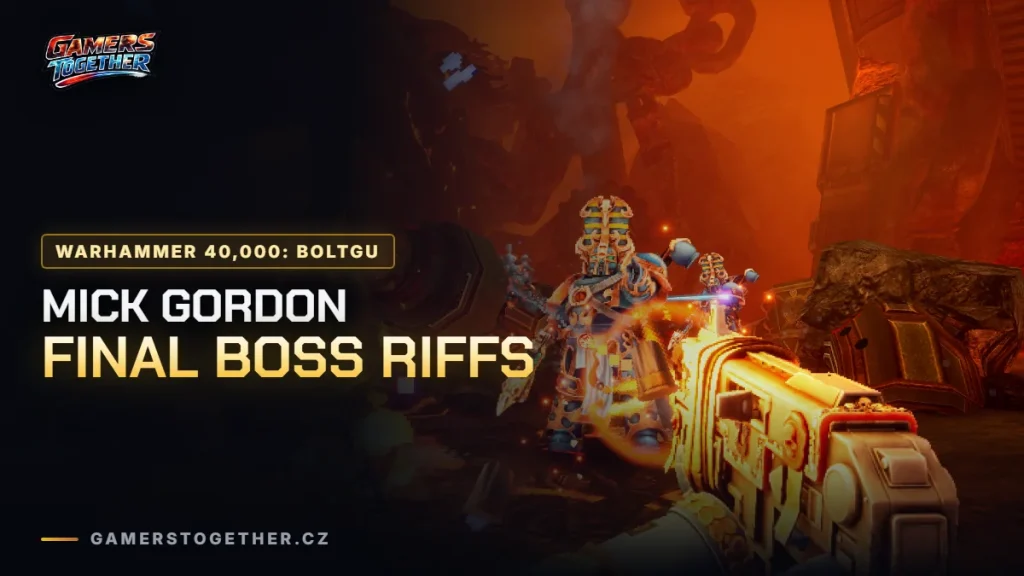
Warhammer 40,000: Boltgun 2 ends with a boss fight on a scale the first game never attempted, and the music behind it comes from a name shooter fans know well. Mick Gordon, the Australian composer behind the soundtracks to 2016’s Doom and Doom Eternal, wrote the track Ascent of the Arkifane for the sequel’s climax at the invitation of developer Auroch Digital.
How the collaboration started
Gordon says the connection goes back to the original game. After playing the first Boltgun, he emailed the team to tell them he thought the combination of a pixelated, sprite-based boomer shooter and the Warhammer 40K universe was the obvious idea nobody else had gotten around to. That email turned into a relationship, and when the sequel was in production, Auroch Digital came back to him with a pitch: a giant end-of-game boss battle that needed something big, bombastic and a little bit silly to match it.
For Gordon, it was an easy yes. He had never worked inside the Warhammer universe before, despite wanting to, and the project stacked a Doom-inspired first-person shooter, retro pixel visuals and a demonic boss encounter into a single job. If you want a sense of how crowded that retro-shooter corner of Steam has become, we also covered Cyberfrags ’69 recently.
No folder of leftover riffs
Asked whether he keeps a stash of unused shooter riffs ready to deploy, Gordon pushed back hard. He described his job as finding a unique voice for each project – an idea that occupies its own space and can’t be shoved into someone else’s. He admits you can never fully separate yourself from your own taste, but says he doesn’t recycle material between games.
He also didn’t play the boss fight himself. Games are often unstable and not much fun until they’re close to release, with multiple builds a day, so instead the QA department sent him capture footage, screenshots and concept art.
Finding the tempo on the couch
Gordon’s method for that footage is deliberately low-tech. He puts the video on his television, sits on the couch with an unplugged controller in his hands and imagines himself playing for the first time. A metronome app rests on his thigh while he taps out tempos and writes them in a notebook – one level at 99 beats per minute, another at 138, another at 216.
The reason is practical. Music that’s too fast becomes overwhelming and sends players into the options menu to turn it down, which Gordon calls a total failure. Music that’s too slow makes an otherwise tight, polished game feel sluggish. Once the tempo is locked, everything else gets built on top of it. If you like games where the rhythm is baked into the design itself, we also wrote about Nocturne.
Why only 6% hearing it is fine
Gordon starts every project from a blank canvas with nothing handed to him – no key, no tempo, no brief – so the work is a back-and-forth with the team, who help him choose between the endless options a laptop studio allows. He says involving the developers in those decisions makes them feel like part of the music.
Scoring the climax also plays to a part of his personality he jokingly calls unsavory: in a final boss fight he gets to be the loudest, most obnoxious presence in the room. And he’s fully aware that, judging by Steam completion numbers, something like 6% of players may ever reach that fight. He doesn’t mind. He compares it to finding a secret area as a kid – a hidden thing that creates a closer relationship between the game and the player. He pointed to Doom’s Rip & Tear, which runs about 28 minutes in the game while the album version is roughly three.
The player as conductor
Gordon’s broader philosophy is what he calls forward momentum. Games, he argues, are the only art form with a direct link between audience and work – a painting or a film sits at a distance, but a game does nothing without your input. Technically, his score for a game is effectively one three-to-five-hour song broken into segments that rearrange themselves based on what you’re doing: low health, a new level, a boss, playing with friends. The player, in his words, is the conductor.
Where to play it
Warhammer 40,000: Boltgun 2 is out now on PlayStation 5, PC and Xbox Series X|S, with a Nintendo Switch 2 version coming later. For more releases and industry news, keep an eye on our gaming articles.
FAQ
He wrote the track Ascent of the Arkifane, which plays during the large final boss battle at the end of the game. The rest of the soundtrack isn’t his work.
No. Builds change several times a day during development, so the QA team sent him capture footage, screenshots and concept art instead. He says video is what he likes best.
He watches gameplay footage on his TV holding an unplugged controller, imagining himself as a first-time player, and taps out beats-per-minute values on a metronome app before writing them down.
It’s available now on PlayStation 5, PC and Xbox Series X|S. A Nintendo Switch 2 version is planned for a later date.
Not at all. He estimates roughly 6% of players reach a final boss and says he likes that those players get something specific and unique, comparing it to discovering a secret as a kid.