
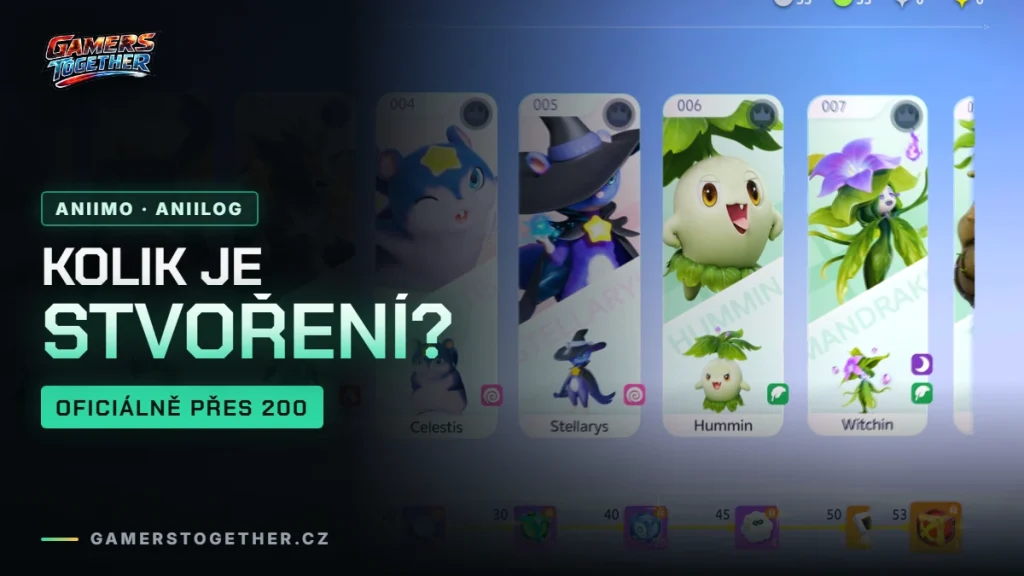
The Aniilog is the game’s creature compendium – it tracks what you’ve caught, in which form, and what you get for it. Officially, Aniimo has 200+ creatures. No two sources agree on the exact count of base species, though, and there’s a real reason for that. If you don’t know the game yet, start with what is Aniimo and come back here after.
- Officially the game says 200+ creatures, and that figure already includes evolution stages and variants.
- Databases disagree because each one counts a different unit – species, form, or index entry.
- Before trusting any database, check what one entry in it actually means.
- The Aniilog isn’t just a list – it’s also part of your in-game progress.
How many creatures are in Aniimo
The official figure is simple: 200+ creatures. It comes from publisher FunPlus and from the Xbox Game Pass listing, so it’s backed independently in two places. There is no single confirmed number for base species.
The catch is what “200+” actually counts. It bundles every form and variant together – it isn’t a count of base species. It’s a floor and a marketing round number, not a precise total.
The phrasing itself hints at that. A “200+” with a plus sign is wording that deliberately leaves room to grow. If the publisher wanted to state an exact total, it would print a specific number instead of an open-ended floor. Reading it as “at least this many” is the safer interpretation, not treating it as a precise inventory.
How many base species exist, officially, isn’t published anywhere – the studio didn’t release that number even at launch. Anything more specific you find online comes from fan databases, and they don’t agree with each other. The next section explains why.
Why the databases don’t match
Six different databases and aggregators quote six different numbers for base creatures, and three different numbers for the total form count. That isn’t a mistake on their part – each one is simply counting a different unit.
Worth noting: this isn’t unique to Aniimo. Any creature-collecting game with a large enough roster eventually runs into the same question – what actually counts as “one” creature. Aniimo just makes it more visible, because it stacks evolution stages on top of regional and seasonal variants at the same time, which widens the gap between the lowest and highest estimate more than usual.
Table: who reports which number
Here’s how it looked across sources as of September 22, 2026:
| Source | Base creatures | Total forms |
|---|---|---|
| FunPlus (official marketing) | – | “200+” |
| Game8 | – | 206 |
| aniimotools.dev | 92 | 223 |
| aniimoguide.com | 95 | 219 (95 + 124 forms) |
| aniimo.website | 75 profiled | – |
| other aggregators | 88 (+2 special), 91, 94 | 130 forms |
The numbers range from 75 to 99 for base species, and from 206 to 223 for total forms. None of them is “the real one” – each just describes that particular database, not the game itself.
Base species vs. evolution stage
Most of the gap starts right here. Creatures in Aniimo can go through up to three evolution stages – Lumin, Gamma and Nova. If a database counts each stage as its own index entry, one species shows up in its list three times. Our piece on creature evolution covers exactly how that progression works.
That’s why numbers hovering around ninety base species balloon toward two hundred once you count forms in some sources. It isn’t a different game – it’s a different counting method.
Regional and Prismana variants
On top of the stages sits a second layer: regional variations and the so-called Prismana variant, a weekly rotating special version of certain creatures. Some databases log these as separate entries, others fold them under the base species – and that accounts for another slice of the gap in the table above.
Exactly what determines a given creature’s form in each case can’t be pinned down reliably from what’s currently available. Until that’s confirmed, we’d rather not state it as settled fact here.
What else skews the counts
Add to that the content that arrived after launch through seasonal updates, entries from the closed beta that never made it into the live game, and so-called combat forms, which don’t always get counted the same way as collectible entries.
One aggregator even ties its number explicitly to a specific season and region rather than the game as a whole – exactly the kind of footnote most readers skip right past.
That has a practical consequence for this article, too: the table above isn’t carved in stone. It will shift alongside seasonal updates even within a single source, so we’ll revisit this piece with major patches to keep it matching the current state, not the state at launch.
How to read any creature database
Before you treat any creature database as reliable, ask three questions: Does it count evolution stages separately? Does it count regional and Prismana variants separately? When did it last update its data? The answers tell you more than the headline number ever will.
Most databases, including the in-game Aniilog, let you filter along three axes. The first nine are elements – holy, fire, ice, dark, electric, grass, water, rock and wind. The next five are roles – DPS, Heal, Support, Break and Regen. The last three are evolution stages – Lumin, Gamma and Nova.
Naming varies between sources: what one site calls holy, another writes as Light, rock sometimes shows up as Earth and electric as Lightning. The safest bet is to stick with the official wiki’s naming and treat the mismatch as a naming quirk, not a different mechanic.
In practice, that means if someone tells you “this creature is fire-type and in the BREAK role,” you have enough to look it up in any database yourself, including the official one, regardless of whether it uses English or localized terms. These three filters work as a shared language across sources.
What affects how many creatures you run into
How many different species show up in your Aniilog doesn’t depend only on how long you’ve played. Creature spawns in the open world are governed by environment, weather, time of day and rare occurrences – the same spot can offer different creatures depending on the hour or the weather. Someone who only explores at night under clear skies will see a different slice of the Aniilog than someone who covers the same area during a storm at dawn.
Catching requires a trap called an Aniipod and the right timing – not every encounter automatically means a new index entry. And even after a successful catch, evolution only awaits most creatures, not all of them, so not every base species covered above necessarily grows through all three stages.
It also matters whether you explore alone or in co-op with other players – Aniimo supports a shared open world, and each of you will naturally run into different creatures depending on where you each wander off to. If you want the widest possible spread in your Aniilog, one biome and one time of day won’t get you there.
The Aniilog isn’t just a list
Every major database turned the Aniilog into a clickable table. In the game itself, it’s more than that – it logs what you’ve discovered and caught, making it part of your progress, not just a reference list.
The difference between “a table” and “a progression system” is also a difference in perspective. An external database always shows you the same generic data as everyone else. The Aniilog inside the game reflects your own progress instead – what you personally have discovered and caught, not some theoretical maximum.
A full name-by-name catalog deliberately doesn’t belong in this piece. That catalog already exists on specialized sites, updates daily, and we wouldn’t be able to keep it at that quality anyway. The goal here is to help you understand the numbers, not replace them. Before you start filling out your own Aniilog, check catching creatures.
Which creatures to collect first
The only two names we’re confident enough to name here are the starters, Helion and Lunara – you get one of them right at the start of the game. According to one available tier list, both remain viable even in the endgame, though that’s a claim from a single source, not our own rating.
A full breakdown of who to level and why goes beyond this article – we have a dedicated tier list for that. Here, all that matters is that your very first decision, which starter to pick, isn’t one you need to stress over: the available data suggests you won’t lose out either way.
We’ll leave the rest of your early Aniilog entries to you. That’s deliberate – a name list would tell you less than working through the first few dozen creatures yourself and seeing firsthand what a given area and weather actually turn up. The rest of our Aniimo coverage picks up from there, from team building to rating what you’ve caught.
FAQ
Officially 200+ creatures including every form and variant – a figure used by both publisher FunPlus and the Xbox Game Pass listing. The exact number of base species varies between databases, since each one counts a different unit: species, form, or index entry.
Because each one counts a different unit. Some only count base species, others add evolution stages Lumin, Gamma and Nova as separate entries, and some also log regional and Prismana variants separately. None of the resulting numbers is wrong – each just describes a different thing.
The in-game creature compendium, which tracks what you’ve discovered, caught and in which form. Unlike a database on some other site, it reflects your own progress in the game, not a generic list available to everyone else.
Nine: holy, fire, ice, dark, electric, grass, water, rock and wind. Along with five roles and three evolution stages, you can filter by them directly in the in-game Aniilog.
Three: Lumin, Gamma and Nova. That distinction is the main reason form counts and base-species counts differ so much between sources – if a database counts each stage separately, one species shows up in its index three times.
None of them is unconditionally reliable, since they differ in methodology. Before you use one, check three things: whether it counts evolution stages separately, whether it counts regional and Prismana variants separately, and when it last updated its data.