
Updated 3 October 2026, 14:00
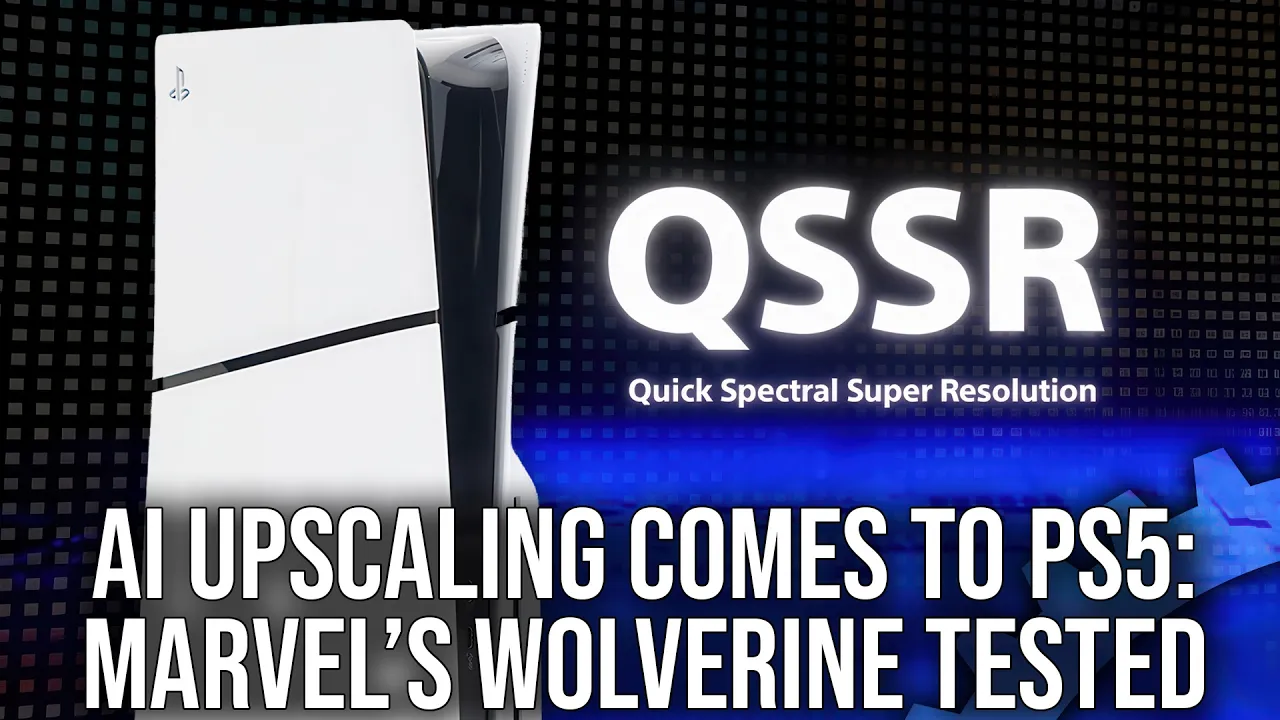
AI upscaling has quietly become a standard part of modern rendering, but the base PlayStation 5 has been left out of it. PSSR was built around the stronger GPU inside the PS5 Pro, so owners of the standard console have had to make do with traditional temporal upscaling. That’s changing now – Sony has introduced a new model called Quick Spectral Super Resolution, QSSR for short.
What QSSR actually is
Sony described the new model in a post on the official PlayStation Blog. QSSR comes out of Project Amethyst, the collaboration with AMD that started last year and that also produced PSSR, which landed earlier this year on the PS5 Pro.
The key difference is weight. QSSR is a far lighter model than PSSR, and that’s exactly why it can run on the weaker GPU in the standard PS5. The base console doesn’t have a dedicated machine learning compute unit like the PS5 Pro does, so the whole thing hinges on an optimized neural network architecture. On top of that simplification, Sony leans on a hand-tuned implementation built specifically for the base console.
The trade-off is predictable: QSSR won’t hold onto fine detail as well as PSSR does on the Pro. Compared with the temporal upscaling consoles have used so far, though, it should be noticeably more accurate – and if you play on a base PS5, that’s the comparison that matters.
Sony is also clear that QSSR is not a replacement for PSSR. PSSR stays exclusive to the PlayStation 5 Pro, and QSSR is presented as a new performance tier of AI upscaling rather than a successor. If you’d rather not use it at all, you can switch the feature off completely in the console settings.
Where you can see it first
QSSR debuts in two games: Marvel’s Wolverine and Ghost of Yotei. Patches for both were set to go live the same day the technology was announced.
Insomniac’s Head of Technology Mike Fitzgerald said QSSR adds more pixel-level clarity and stability to the studio’s environments and pulls extra detail out of the busy streets of Madripoor, the dense alleyways of Shinjuku and other areas across Logan’s journey. In his words, it gives PS5 players a taste of the PS5 Pro experience.
Jasmin Patry, Lead Rendering Engineer at Sucker Punch, said QSSR excels at resolving fine detail in characters and environments and delivers a level of temporal stability that hasn’t been possible on the PS5 until now. He called it a positive step toward letting every PS5 player enjoy image quality close to what PSSR offers on the Pro.
What the comparisons show
Sony’s blog published side-by-side clips from both games against the standard temporal upscaling on the base PS5:
- Marvel’s Wolverine – the camera zooms in on distant buildings. The QSSR footage is still fairly soft, which is what you’d expect from a stripped-down model, but it holds together far more detail in small objects than the standard sample.
- Ghost of Yotei – the shot zooms in on foliage in the foreground. In the original PS5 footage the grass breaks down into floating green lines chopped up by aliasing. With QSSR on, the grass keeps its actual shape, even if the image is still a bit noisy.
Testing by Digital Foundry points the same way. In Marvel’s Wolverine the difference against Insomniac’s own ITGI upscaler is said to be clearly visible – QSSR cuts down on visual noise and improves vegetation as well as detail on character models. In Ghost of Yotei the gap against FSR3 is smaller, but the image is cleaner with QSSR, and the performance cost of both solutions is comparable.
What it means for you
Sony says it is making QSSR available to all developers, so more studios are likely to adopt it over time. There’s also a chance older titles that already support PSSR will pick up QSSR as well. Whether the upcoming GTA 6 will support it hasn’t been confirmed.
That matters mainly because the PS5 Pro now costs $900 – this lighter model brings AI upscaling to a much larger group of players without anyone having to buy new hardware. If you’re still weighing which console to go with, we compared PS5 and Xbox Series X in a separate article, and we also have a walkthrough of the PS5 first setup.
So far we’ve only seen the model in a handful of clips and early testing, so the real verdict will come from the two patches themselves. One thing is clear: if you don’t plan to jump to new hardware anytime soon, QSSR is a way to squeeze extra image quality out of the console you already own.
Where to go next
We covered the system update that switched on enhanced PSSR, and you’ll find more news on the platform in our PlayStation section. If you want to add a games catalog and online play to your console on top of that, there’s the PlayStation Plus subscription page.
FAQ
Quick Spectral Super Resolution. It’s a new AI upscaling model from Sony designed for the standard PlayStation 5.
QSSR is a far more lightweight model with a simplified neural network architecture and a hand-tuned implementation for the base PS5, which has no dedicated machine learning compute unit. It won’t preserve fine detail as well as PSSR does on the PS5 Pro, but it should be more accurate than the temporal upscaling used on the console until now.
No. PSSR remains exclusive to the PlayStation 5 Pro, and Sony describes QSSR as a new performance tier of AI upscaling.
It debuts in Marvel’s Wolverine and Ghost of Yotei. Patches for both were going live the same day the technology was announced, and older games that already support PSSR may get it later.
Yes. The feature can be disabled entirely in the console settings.