
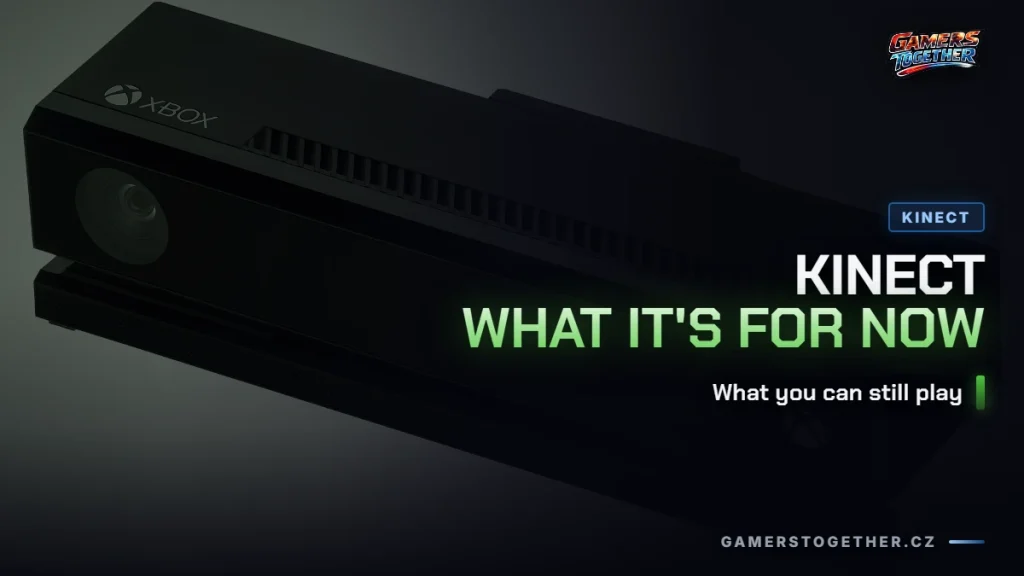
Xbox Kinect is a motion sensor that tracks the player in front of the TV instead of a controller. You can’t buy one new anymore: Microsoft ended production of the Xbox One version on 25 October 2017 and pulled its separate adapter from sale in January 2018. You can still find one second-hand, but before you buy, check what your specific console needs, because that’s where most purchases go wrong.
Why Kinect was a big deal in its day
The Xbox 360 sensor launched in North America on 4 November 2010 and reached the rest of the world by 20 November. Roughly 8 million units sold in the first 60 days, which earned it a Guinness World Records entry as the fastest-selling consumer electronics device. Around 35 million units sold over its lifetime, so basements and second-hand listings are still full of them.
By the way, people often search for it as “kinetic”, a typo that some sellers stick to as well. The correct name is Kinect, without the second “i”.
Where Kinect works and where you need to check
| Console | How it connects |
|---|---|
| Xbox 360 | The sensor for this generation came out in November 2010, and this is its original home |
| Xbox One (original model) | Has a dedicated Kinect port right on the console |
| Xbox One S | No dedicated port, the sensor can only be connected through a separate adapter |
| Xbox One S adapter | Microsoft pulled it from sale in January 2018 |
| Xbox Series X and Series S | Microsoft doesn’t list the sensor for this generation at all, so check support before you buy |
That last row needs some explanation. Microsoft never claims that Kinect runs on Series X|S, nor that an adapter exists for this generation. All that can be documented is that the sensor doesn’t appear in the descriptions of the new consoles and that the last official adapter stopped selling in January 2018. If you buy a sensor for a newer console, you buy it at your own risk and should check support before you send any money. What the new generation can do instead is covered in our comparison of Xbox Series X and Series S.
The adapter is the main obstacle today
The most common combination people run into is the Kinect sensor for Xbox One and an Xbox One S console. The S model lost the dedicated port the original Xbox One had, so you can’t connect the sensor without an adapter. The adapter splits the sensor’s connection into USB and a separate power supply, and Microsoft discontinued it in January 2018, explaining that it was shifting production to other, more popular accessories for Xbox One and PC.
In practice, that means two things. First, when you look at a second-hand listing, check not just the sensor but also whether the adapter is in the box. Second, the adapter is only available second-hand today, so expect it to take longer to find than the sensor itself. With the Xbox 360 Kinect, this problem doesn’t exist, because it plugs straight into its own console generation.
What you can still play with it
Microsoft doesn’t maintain a verifiable list of Kinect games today, so we’re not making one up here. The workable approach is the reverse: every game in the Xbox store lists its supported platforms, so you can check the status on its store page. Keep in mind that digital purchases for the older generation are over: Microsoft closed the Xbox 360 store on 29 July 2024, and what that means for a library you already own is covered in Xbox 360 today and what still works on it. That leaves second-hand discs, and our pick of the best Xbox 360 games comes in handy for those.
One thing gets mixed up a lot: motion games have nothing to do with backward compatibility. Backward compatibility is about whether an older title launches on a newer console, not whether you can connect a peripheral to it. How it works is explained in our article on Xbox backward compatibility.
Where the technology went
Kinect ended as a gaming accessory, but Microsoft kept working on spatial sensing. The sensor technology became part of HoloLens, which Microsoft first released in 2016. The second line was the Azure Kinect DK developer kit: a depth sensor, a spatial microphone array with a camera and an orientation sensor, plus a developer kit for body tracking and image and speech processing. It was used outside gaming, mainly for computer vision.
That branch is closed too, though. Microsoft announced the end of the Azure Kinect DK hardware kit in October 2023, and its documentation has since been moved to an archive on Microsoft’s website. So if you’re looking for a Kinect for your own project today, you’re buying hardware that no longer has any active support.
Is Kinect worth buying today?
- It makes sense if you have an Xbox 360 or an original Xbox One and want to replay motion games you once owned. There, connecting it has no catches and you can plug the sensor straight in.
- It makes sense as a cheap depth sensor for tinkering with your own project, but only if you don’t mind that official support has ended and the documentation for the newer kit is archived.
- Don’t buy it for an Xbox One S without an adapter. Without one, you can’t connect the sensor, and the adapter hasn’t been made since January 2018.
- Don’t buy it for a Series X or Series S hoping it’ll work somehow. Microsoft says nothing anywhere about sensor support for this generation. If you’re looking for accessories for a new console, start from what’s included in the price instead: see our overview of how much each Xbox costs today.
- Don’t buy it as a way into the new generation of games. The sensor adds nothing to today’s titles, and the current lineup is better summed up by our pick of the best Xbox games.
FAQ
It isn’t documented either way. Microsoft doesn’t mention the sensor at all in its Series X|S materials, and it pulled the last official Kinect adapter from sale in January 2018. Before you make that purchase, check support for your specific console and with the seller, because it can’t be confirmed from Microsoft’s public sources.
The correct spelling is Kinect. The “kinetic” variant is a common typo that persists in second-hand listings too, so it’s worth searching for both. When a seller writes kinetic, it isn’t a different product, just a misspelled name.
It depends on the model. The original Xbox One has a dedicated port for the sensor, so you don’t need an adapter. The Xbox One S doesn’t have that port, and you can’t connect the sensor without a separate adapter that splits its connection into USB and power. Microsoft discontinued the adapter in January 2018, so second-hand is the only option left.
Microsoft ended production of Kinect for Xbox One on 25 October 2017, and when it discontinued the adapter a few months later, it spoke of shifting production to other, more popular accessories. The sensing technology itself lived on in HoloLens and in the Azure Kinect DK developer kit.
Microsoft carried Kinect’s spatial sensing over to HoloLens, released in 2016, and to the Azure Kinect DK kit with a depth sensor, a microphone array and body tracking. That kit has been discontinued since October 2023, though, and Microsoft keeps its documentation in an archive, so there’s no point building a new project on it.
Information verified as of 11 September 2026. Sensor support on Series X|S consoles is neither confirmed nor ruled out, so expect to do some checking before a second-hand purchase. More articles about the brand are collected in our Xbox hub on Gamers Together, and whether the previous generation still makes sense today is covered in is the Xbox One still worth it.