
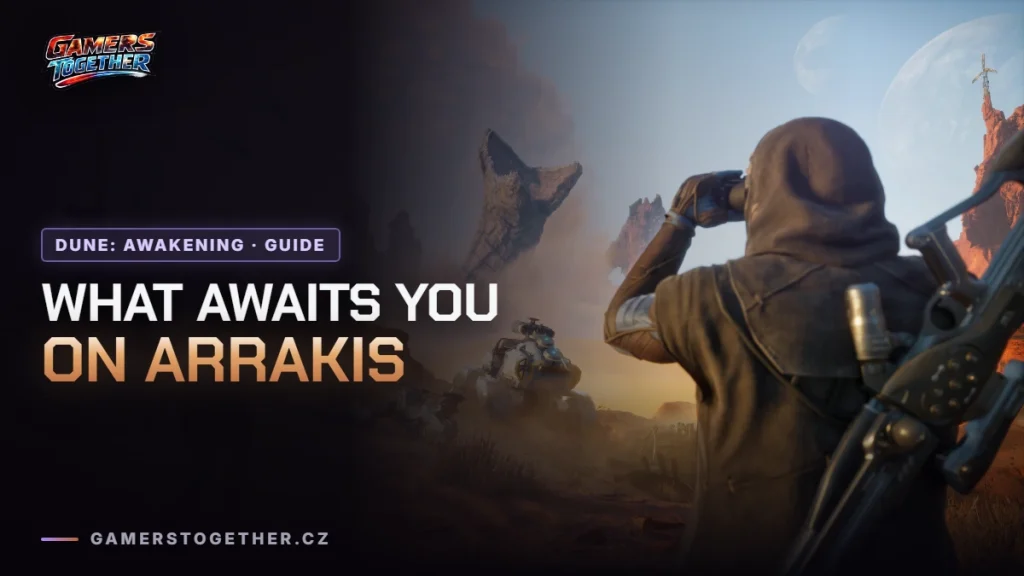
Dune: Awakening is an open world survival game with RPG elements from Funcom, set on the desert planet Arrakis. You play an undercover Bene Gesserit agent tasked with finding the vanished Fremen. You survive thirst, gather resources, build a base and fight – on your own, with a group of friends, or on a server with hundreds of other players.
Quick summary:
- It’s a survival game with an RPG layer from Funcom, not a classic MMO like World of Warcraft.
- The gameplay loop runs from survival through crafting and base building all the way to Landsraad politics in the endgame.
- Since update 1.5 you can play the entire game purely solo and you can switch PvP off.
- The game releases on PS5 and Xbox Series X/S on September 22, 2026, with head start access for Deluxe and Ultimate running from September 17.
If you’re looking for specific guides, start at the hub for all our Dune: Awakening guides. This article is an introductory overview for anyone who hasn’t played the game yet.
What kind of game this actually is
Dune: Awakening is a survival game with MMO elements. Funcom itself describes it as an open world multiplayer survival game that builds on the foundations of the genre and adds an MMO layer on top – shared social hubs, guilds and politics across the whole server.
The closest comparison for someone who knows the genre: picture Conan Exiles moved to Arrakis and fitted with the progression schools from Dune. It has almost nothing in common with the structure of World of Warcraft; there are no quest hubs with tab-target combat here.
The game launched on June 10, 2025 on PC, with early access starting on June 5. It runs on Unreal Engine 5. Critical reception landed on 78 points on Metacritic and 79% of reviewers recommended the game on OpenCritic. On launch day it passed 140,000 concurrent players on Steam and sold a million copies within two weeks.
Wondering whether you can play in your own language? Take a look at which languages Dune: Awakening supports – the answer may not be what you were hoping for.
The story and the world of Arrakis
The story takes place in an alternate timeline, which the game introduces in its opening scene. Paul Atreides was never born. Following the orders of the Bene Gesserit, Lady Jessica gave birth to a daughter, Ariste, and thanks to her loyalty she went through the Truthsayer training and uncovered the betrayal of Doctor Wellington Yueh.
The events of the first book therefore never happened. House Atreides survived under Duke Leto and is waging a drawn-out war of assassins against the Harkonnens on Arrakis. The Fremen disappeared after the Sardaukar purge.
You play an undercover Bene Gesserit agent whose job is to find the Fremen and “awaken the Sleeper”. At the start you create a character, pick their origin and a mentor who determines your starting ability. Later on you side with either the Atreides or the Harkonnens.
The main adversary isn’t any of the houses, though. It’s the planet – the heat, the drought, the storms and whatever moves beneath the sand.
The story continues in Chapter 2. If you get stuck in it, work through our overview of the Chapter 2 quests.
What the gameplay loop looks like
The basic loop is simple and repeats over and over; only the scale shifts. It goes like this:
- Survive. Watch your water level, stay in the shade and maintain your stillsuit (a suit that recycles your body’s moisture back into drinking water).
- Gather resources. Wrecks, plants, ores, spice. Anything the desert leaves you.
- Craft. Tools, weapons, gear and machines that give you access to further resources.
- Build a base. From a sheet-metal shelter against the storm up to a fortified workshop with a spice refinery and generators.
- Explore. Hagga Basin, testing stations, caves and dungeons, and later the Deep Desert.
- Improve your character. Unlock abilities across the Schools of the Imperium and collect augments.
- Get to the technology. Better vehicles, and the ornithopter (a flying machine with flapping wings, your first real freedom of movement).
- Play the endgame. Spice harvesting in the Deep Desert, guilds and Landsraad politics (the council of houses through which guilds influence the state of the whole world).
Funcom splits the whole progression into four official phases: Survive, Protect, Expand and Control. The first phase is about bare survival, the second about securing what you’ve built, the third about pushing into more dangerous areas and the fourth about fighting for influence at the level of the entire server.
The difference from a lot of other survival games is that the loop isn’t just farming for the sake of farming. Every step opens up a specific piece of the map or a specific mechanic you couldn’t reach before.
Survival on Arrakis
Water is the main currency of your first hours. Thirst ticks away constantly, the sun speeds it up, and the stillsuit is the only reason you can stay outside for more than a few minutes. You get water from plants, from the blood of enemies and from morning dew.
On top of that come sandstorms, overheating and quicksand. The storms aren’t set dressing – if one catches you in open terrain with no shelter, you usually don’t survive it.
And then there are the worms. Shai-Hulud reacts to noise and vibrations, so moving across open sand means going carefully and slowly. Thumpers (devices that pound rhythmically into the sand) can lure a worm to a particular spot, which comes in handy both for spice harvesting and for getting away. If a worm swallows you, you lose everything you’re carrying.
That pressure is what holds the game together. You’re always counting how much water you have left and whether you’ll make it back.
What to expect in your first few hours
The first two to three hours look almost like a different game from the later phases. You’ll be moving on foot, sticking to the shade of the rocks and making short trips out from your base. Your gear is single-use, the map is small as far as you’re concerned, and your main enemy is thirst.
The turning point comes once you build your first proper base and get production running. From that moment on you’re dealing with logistics instead of survival.
Crafting, bases and vehicles
Crafting is the core of the whole game. Resources from the desert go into production stations, which turn out better tools, weapons, vehicle parts and eventually spice refineries. The progression is tiered – without one machine you can’t get to the next.
Base building starts with a simple shelter against the storm and ends with a fortress complete with power generators, storage and a workshop. The materials and building styles reference the houses of Dune, so your base can look Atreides or Harkonnen. The houses themselves also play a role in character creation, where you pick your origin.
Count on moving your base at some point. As you push further across the map from the starting zone, commuting stops making sense and it pays to rebuild closer to whatever you’re currently harvesting.
Vehicles are the other half of the story. First a buggy, then the ornithopter, which turns a several-minute trip into a half-minute flight and opens up parts of the map you can’t sensibly reach on the ground.
Working out which house to align with? Go through our overview of all 25 houses in Dune: Awakening and pick the one that suits you.
Combat and the Schools of the Imperium
Combat is action-based, not turn-based or tab-target. You aim, block and dodge.
The key mechanic is Holtzman shields. A shield deflects fast-moving projectiles, so once enemies start wearing shields, ordinary firearms stop being effective. What works against a shield is a slow blade – a charged melee attack that gets through the shield if you time it right. The other route is to overload the shield with a disruptor and then finish the enemy off with a normal strike.
In practice that means the further you get in your progression, the more often you end up in melee.
You develop your character through the Schools of the Imperium. There are five of them:
- Trooper – heavy weapons, firepower and defensive techniques.
- Swordmaster – close combat, parrying and blocking projectiles.
- Mentat – tactical gear, traps and exploiting enemy weaknesses.
- Bene Gesserit – the Voice for controlling enemies, plus special movement abilities.
- Planetologist – mining, vehicle maintenance, mapping and water management.
During character creation you pick from four schools. The Planetologist is the exception – you have to learn that one in-game from the trainer Derek Chinara, who camps in Hagga Basin South near one of the imperial testing stations. The same goes the other way: the trainers of the remaining schools will take you on as well over time, so you’re not locked into one role forever.
Beyond the schools, you upgrade your character with augments. If you’re weighing up what to fit first, we have a separate guide to augments.
Do you play solo, with friends, or in an MMO?
Since update 1.5 you can choose any of the three, and each one contains the whole game.
Solo. Update 1.5 added a full single-player mode. According to Funcom it’s the complete game on every platform, including access to the Deep Desert, where in solo the map doesn’t reset and buildings don’t disappear. The Coriolis storm is still there in solo, but it no longer kills players instantly. The Landsraad endgame simulates the other guilds’ push for power. On top of that you pick from three difficulty presets, or stack the settings yourself.
There really is a lot you can set: storms, safety zones (you can switch all of Hagga Basin to PvP, or all of it to PvE), harvesting and experience multipliers, building part limits, item durability, base decay, automatic worm and Coriolis storm spawns, what you drop on death and how many plots you’re allowed to claim.
With a group. Funcom supports renting private servers through official partners. You can lock a server with a password and set your own rules on it, including PvP turned off. Every private server still belongs to a wider World, so you share social hubs and the Deep Desert with other servers.
On official servers. The classic option, with hundreds of players in a shared world, guilds and Landsraad politics.
PvP isn’t compulsory. It’s concentrated mainly in the Deep Desert, the endgame zone that the Coriolis storm redraws every week, shifting the interesting spots around. On a private server and in solo you can turn it off completely.
Dune: Awakening on PC, PS5 and Xbox
On PC the game has been out since June 10, 2025. At minimum you need 16 GB of RAM, a quad-core on the level of an Intel Core i5-7400 or Ryzen 3 1200, a GeForce GTX 1060 (6 GB) or Radeon RX 5600 XT (6 GB) graphics card and 60 GB of space. The recommended configuration calls for a Core i7-10700K or Ryzen 5 2600X, an RTX 3070 (8 GB) or Radeon RX 6700 XT and 75 GB of space. An SSD pays off in both cases. We have the full table in our article on the system requirements.
On PlayStation 5, PS5 Pro and Xbox Series X/S the game releases on September 22, 2026. Deluxe and Ultimate pre-orders got head start access as early as September 17; the full console launch, including physical editions, isn’t until September 22. Update 1.5 has, according to Funcom, been out on all platforms since September 17.
How much it costs and which edition makes sense we cover separately in our article on the price of Dune: Awakening on PS5 and Xbox.
FAQ
An open world survival game with RPG and MMO elements from Funcom, set on Arrakis. It isn’t a classic MMO like World of Warcraft. It’s closer to Conan Exiles in a Dune setting: you survive, craft, build a base and fight, whether on your own or with other players in a shared world.
Yes. Update 1.5 added a full single-player mode which, according to Funcom, contains the complete game on every platform. You also get the Deep Desert, where the map doesn’t reset for you, and you pick from three difficulties or set your own rules.
No. PvP is concentrated mainly in the Deep Desert, which is an optional endgame zone. On a private server and in single-player you can set the safety zones so that all of Hagga Basin is PvE. You can also do the opposite and open up the entire map for PvP.
You watch your water and survive the storms, gather resources, craft gear, build and upgrade a base, develop your character through the Schools of the Imperium and gradually get to vehicles and the ornithopter. The endgame is then about spice in the Deep Desert and Landsraad politics.
There is no official region-locked server list, but you can rent a private server from one of Funcom’s official partners, lock it with a password and play on it only with the people you invite. You’ll find the details and the list of providers on the game’s official private server page.
Funcom runs an official Discord, and fan-run groups exist on Discord and Facebook where players look for teammates. We don’t recommend any particular one and we haven’t verified how active they are.
September 22, 2026 on PlayStation 5, PS5 Pro and Xbox Series X/S. Owners of pre-ordered Deluxe and Ultimate editions got into the game as early as September 17 as part of the head start. Physical editions only come out with the full launch on September 22.
Surviving on Arrakis is hard, especially in the first hours, when a storm or a moment’s inattention near the sand can kill you. Combat is fairly straightforward. Since update 1.5 you can also set the difficulty to suit yourself in solo and on a private server.
The details about the game’s content, update 1.5 and the release dates are verified as of September 21, 2026 against Funcom’s official sources (duneawakening.com, the Funcom Help Center) and the game’s Steam page. If you want to go deeper, have a look at our Dune: Awakening review, at the system requirements, at the Chapter 2 quests or the guide to augments, or head back to the Dune: Awakening hub.