
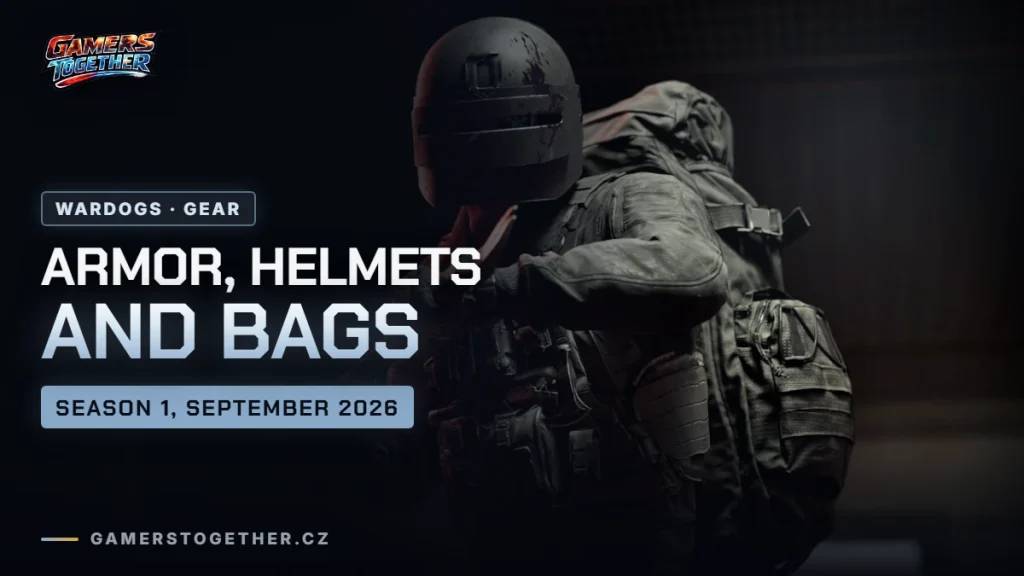
Body armor and helmets in WARDOGS are unlocked through your overall Career level, starting with Level 1 Armor at Career 3, and after that you buy them at the vendor for every life. If you go down and nobody revives you, you lose everything you were wearing, but you can also strip armor from a fallen enemy.
- Level 1 Armor: Career 3, worth equipping straight away.
- Backpacks: Scout Backpack (8 cells) from the start, Field Backpack (12 cells) at Career 12, Ruck Backpack at Career 55 in Season 1.
- Tactical vest: opens quickslots, the Small Tac Vest is available from the start. Storage space comes from the backpack.
- Weight: heavier gear moves you into higher weight classes and slows you down.
- Prices: they change between seasons, so what counts is the in-game vendor.
Armor levels, the ghillie suit, parachutes and what to buy at which stage are covered below.
How armor is bought and unlocked
Protective gear is unlocked in two steps, the same as weapons. First you reach the required Career level, the overall level that sits above the six role trees, and pay a one-off fee. Only then can you buy the item at the vendor, at its regular price for every life. Besides armor and backpacks, Career also unlocks pistols, AP ammo, the sports parachute and the artillery tank. How levels are collected is explained in the article on roles and progression.
The unlock is permanent, the unit you bought is not. When you get shot down and nobody revives you, you lose the whole loadout including the helmet and the vest, and you buy it again for your next life. But it works the other way round too: you can strip a dead body of all its gear. So you do not always have to buy better armor, you can take it from a fallen enemy. That is exactly why beginners do well to head out cheap and upgrade through loot.
Armor and helmet levels
Helmets and body armor come in several levels marked Level 1 and up, and they are unlocked gradually in Career. You unlock Level 1 Armor at Career 3 and it is worth equipping straight away, as soon as you reach it: it is the first jump in durability that you can afford even on a small budget.
Higher levels follow a simple trade-off. Better protection costs more per life, weighs more and every death with it hurts more. Before you buy the highest available armor, work out whether your budget can carry it too: the rule “buy the cheapest kit that lets you do your job” applies to armor just as it does to weapons.
The exact prices change between seasons. The developers at BULKHEAD announced that every season has a different XP curve and a different item order, and Season 1 itself rewrote the prices and unlock levels of a whole range of things. So for armor, helmets, vests and backpacks, what counts is whatever the in-game vendor shows you in that particular season.
Armor is not the answer to everything either. The most effective thing against it is AP ammo, which Career only unlocks very high up: 7.62×54 AP at level 82 and 5.56 AP at level 83. HP rounds, on the other hand, do more to an unprotected body and lose out against armor. Ammo types and individual weapons are covered in the overview of WARDOGS weapons.
The weight of your gear
Everything you carry weighs something and the game sorts the total weight into weight classes. The higher you climb through them, the slower you are. The highest armor, a full backpack and a heavy weapon together are therefore not automatically the best choice: the extra protection only pays off if you can still move with it and run between cover.
For snipers and medics, who move around a lot, a lighter kit tends to make more sense than the heaviest plate carrier. A player holding a position in one spot, on the other hand, can afford the extra weight.
The tactical vest and quickslots
Do not mix up the tactical vest and the backpack, each does something different. The vest opens up quickslots, meaning places for items you want instantly to hand without opening the inventory. A monocular fits nicely in one, for example, which you unlock at level 2 of the Recon tree and which you use to mark enemies for the whole team. The space for your things comes from the backpack, though, not the vest.
The smallest Small Tac Vest is available from the start and belongs in the recommended cheap kit. Bigger vests are unlocked further along in Career and open up more quickslots.
Backpacks and the inventory grid
The inventory works as a grid and every item in it takes up a certain number of cells. How many cells you have is determined by your backpack.
| Backpack | Cells | Unlock |
|---|---|---|
| Scout Backpack | 8 | from the start |
| Field Backpack | 12 | Career 12 |
| Ruck Backpack (Large Backpack in the changelog) | – | Career 55 |
A dash means the figure has not been reliably confirmed yet. Season 1 moved the large backpack from Career 56 to 55, but for most players the Field Backpack at level 12 matters more. Four extra cells compared with the Scout Backpack mean more ammo, bandages and tools for your role.
You can save space. Loose ammo is bought in batches of a hundred and takes up only two cells, so it is more compact and cheaper than a pile of full magazines. How the inventory and refilling magazines work in practice is described in the guide on how to start with WARDOGS.
The ghillie suit and parachutes
According to the game’s official description, the ghillie suit is gear for sniping at long range. It comes in two pieces, the Ghillie Body Suit and Ghillie Headwear. How long-range play works and what goes with a ghillie is covered in the guide on sniping and Recon.
There are two parachutes in the game: the basic one and the sports one. The Sports Parachute unlocks at Career 35, Season 1 moved it down from level 36.
What to buy at which stage
The very beginning
Play cheap at the start. The recommended cheap kit of roughly up to $1,000 per life includes the free starter rifle or the T-21, a couple of magazines and loose ammo, bandages, the free Emergency Resuscitator, a Scout Backpack, a Small Tac Vest and binoculars for $75. You have no armor at this stage and that is fine: losing a kit like that will not knock you down.
From Career 3
Add Level 1 Armor. It is the cheapest way to improve your odds of surviving a firefight, and with that the odds of your kit lasting more than one life.
From Career 12
Unlock the Field Backpack with its 12 cells. More space means more ammo, bandages and tools for your role, so you do not have to head back to base as often.
Higher armor levels
Expensive armor means an expensive loss when you die, and on top of that it slows you down. Do not buy gear you cannot afford to lose and pick up better pieces from fallen enemies instead. How to keep an eye on your budget is explained in the article on money in WARDOGS.
FAQ
Level 1 Armor unlocks at Career 3 and is worth equipping straight away. After unlocking it you buy it at the vendor for every life, and higher armor levels unlock further along in Career.
For most players it is the Field Backpack: 12 cells, unlocked at Career 12, four more than the starting Scout Backpack. The large Ruck Backpack unlocks at Career 55 in Season 1.
Helmets come in levels from Level 1 up and unlock gradually in Career, just like body armor. You buy them again for every life and lose them if you die without being revived.
Armor prices change between seasons, so what counts is whatever the in-game vendor shows you. The developers rewrite the price list and the item order every season.
No. You can take all of a fallen enemy’s gear, including their armor and helmet.
A tactical vest opens up quickslots for items you want instantly to hand, such as a monocular. Your inventory space comes from the backpack, not the vest.
Yes. The game sorts weight into weight classes and you move more slowly in a higher class, so the heaviest armor may not be the best choice.