
Riftbound is a physical card game that Riot Games built on the world of League of Legends and Arcane. It came out in October 2025, you can find it in stores and at tournaments, and if you play LoL on PC, you’ll recognize almost every name on the cards. This article explains what Riftbound is, how a game works, what to buy to get started and whether it’s worth getting into at all.
What Riftbound is and why you should care if you play LoL
Riftbound: League of Legends Trading Card Game is a collectible card game developed directly by Riot Games. It launched worldwide on 31 October 2025, and in China a few months earlier. You play it with paper cards, not on a screen, so it’s a completely different product from Legends of Runeterra, the digital card game Riot released earlier, which remains a separate title. You don’t buy Riftbound as a digital bundle in an online store; you pick it up as a booster, a deck or a box at the counter of a game store.
UVS Games distributes the game in English and French, and in China it’s published by Shining Soul under Tencent Games. The supported languages are English, Simplified Chinese and French.
Development is led by Dave Guskin, who previously served as director on Legends of Runeterra, so the team already has experience with a card game in the same universe, just in digital form. Riftbound was in development from 2023 under the internal codename “Project K” before Riot officially announced it and put it on sale.
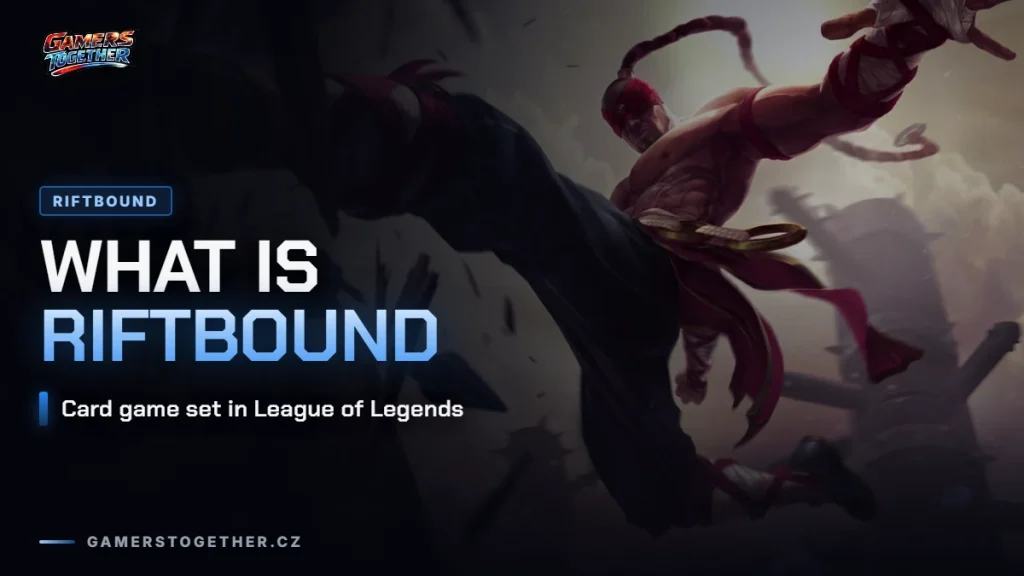
Why it should interest you as a LoL player: the cards feature Jinx, Vi, Viktor, Lee Sin, Shen, Zed and other champions, including their Arcane look. Riftbound isn’t a spin-off with unrelated art slapped on League. It’s a new system, but with the same characters and the same world you spend your time in when you play LoL or watch Arcane.
How it plays: the basics
Riftbound is for 2 to 4 players. You play either a 1v1 duel, 2v2 in teams, or a free-for-all with more players. The goal is to collect Victory Points by conquering and holding battlefields, the locations players fight over during the game. Whoever reaches the target score first wins: 8 points in solo play, 11 in team play.
Every turn you get two new runes. A rune is your resource: either you use it temporarily (you turn it sideways and pay for a regular card), or you return it permanently to the rune deck and pay for a stronger effect that way. This system is the core of the game’s economy. The more runes you sacrifice, the stronger the things you can afford, but then you won’t have them available later.
The fight for a battlefield itself works like this: you put units up against each other, each with a Might stat, which is their combat strength. When only one player’s units are left standing at the end of a clash, that player takes control of the battlefield and scores points. If you can judge when to commit more units to the fight and when to pull back and give up the battlefield, you’ll win more games.
Riftbound has no set rotation so far. Everything Riot has released since launch (Origins, Spiritforged, Unleashed, Vendetta) stays tournament-legal all at once. So you don’t have to worry that a deck you build today will stop working in a few months because older cards “rotate out” of the format. Unlike Magic’s Standard formats, nothing has been removed here yet.
For complete beginners there’s also a simplified format, Proving Grounds. It uses smaller, preconstructed decks and a simpler set of rules than full “Constructed” play with your own 40-card deck. It’s a good way to get a feel for the basic mechanics before you put together your own deck.
The exact rules (how many cards your deck can have, what a turn looks like step by step, everything the cards can do) are covered in a separate article, Riftbound rules step by step.
Cards and mechanics
A deck in Riftbound consists of several separate parts, not a single pile like in Hearthstone or Pokémon:
- Legend (Champion Legend): the core card that determines which champion you play, which direction your strategy takes and which domains (colors) you have access to.
- Units: units and characters, including your champion, with a Might stat.
- Spells: one-off spells with an immediate effect.
- Gear: equipment that strengthens units but doesn’t fight on its own.
- Runes: a separate resource deck that has to match your legend’s domains.
- Battlefields: cards for the battlefields the game is fought over.
The legend is what you build your whole deck around. You pick a champion, it opens up one or two domains for you, and within those you then choose units, spells and gear that make sense in the deck. Runes are their own thing. They aren’t cards you draw from your main deck, but a smaller deck of their own that gives you resources turn after turn.
Domains work much like mana colors in Magic or elements in other TCGs. Every legend belongs to one or two domains, and those limit which cards you’re allowed to put in your deck at all. Champions from other domains that you run into on your opponent’s cards won’t combine with your legend unless you choose your domains so they fit together.
| Card type | What it does |
|---|---|
| Legend | the core of the deck: champion, strategy, available domains |
| Units | units and characters, fight with their Might stat |
| Spells | one-off effects |
| Gear | equipment, strengthens units, doesn’t fight on its own |
| Runes | separate resource deck, provides energy for playing cards |
| Battlefields | the locations you fight over, which carry the points |
The details (exactly how many cards a deck can have, how many copies of the same card, how the sideboard works) are covered in a separate article, cards, mechanics and deckbuilding in Riftbound. In short: according to several independent sources, the main deck has 40 cards including the legend, with a maximum of three copies of any one card, plus a 12-card rune deck. These numbers, however, aren’t based on the official rules PDF, which couldn’t be downloaded at the time of writing. Before you take them as certain, check them in the current rulebook at playriftbound.com.
What to buy when you’re starting out
The easiest way into Riftbound is Proving Grounds, a starter box for 2 to 4 players. Inside are four ready-made decks built around Annie, Master Yi, Lux and Garen, plus battlefield cards, acrylic champion figures and a guide, so you can start your first game right out of the box without buying or assembling anything else. It officially costs $29.99.
If you want to play a specific champion right away, go for a Champion Deck, a ready-made deck built around one legend, such as Jinx, Viktor or Lee Sin. In Czech stores it costs CZK 500 to 600 depending on the set. The alternative is a Showdown Deck, which is two decks aimed directly at each other (for example Shen versus Zed). You buy both sides at once and have a two-player game straight out of the box, for CZK 800 to 850.
Once you want to expand your deck or collect cards, it’s time for Booster Packs with 14 cards for just under CZK 140, or a Booster Box with 24 packs for roughly CZK 2,800 to 3,000. Prices vary by set and store, so treat them as a rough guide.
| Product | What you get | Approx. price in Czech stores |
|---|---|---|
| Proving Grounds | 4 ready-made decks, battlefields, figures, guide | ~CZK 800 |
| Champion Deck | ready-made deck built around one legend | CZK 500–600 |
| Showdown Deck | two rival decks built against each other | CZK 800–850 |
| Booster Pack | 14 cards | ~CZK 140 |
| Booster Box | 24 boosters, 336 cards | CZK 2,800–3,000 |
For a detailed guide on what to buy first and in what order, see the article how to get started with Riftbound: decks and what to buy first.
Where to play and buy Riftbound
Riftbound is sold in regular TCG stores. There you’ll find single cards, boosters and ready-made decks.
Besides buying online, you can also play Riftbound in person. Some TCG stores run their own play spaces with open play nights and regular tournaments. Stores post their exact event calendars and prerelease dates on their own Facebook pages, so check them before you head to the store.
There’s no official digital version of Riftbound yet; it’s played exclusively with paper cards. In the meantime, the community makes do with a Tabletop Simulator mod or playing over webcam, but that’s an unofficial workaround, not a full online game.
If you’d like to at least manage your deck and collection digitally, there are a few unofficial third-party apps (such as RiftMana or Riftbound Companion) for building decks, tracking your card collection and finding events near you. They aren’t game clients, though. You can’t play a match in them, only prepare what you’ll bring to the table.
Who it’s for and who it isn’t
Riftbound makes sense if you enjoy LoL or Arcane and want to spend time with cards instead of a keyboard. You don’t have to be a collector; Proving Grounds and someone to play with are enough. It also suits people who have played other TCGs (Magic, Pokémon, Hearthstone) and want to try a system built around battlefields and runes instead of classic mana.
On the other hand, it’s not worth it if you’re expecting a digital game you can fire up on your phone during a break. That’s still what Legends of Runeterra is for. It’s also not a game for anyone who wants to play alone: without a second player (or at least Tabletop Simulator) there’s no game, because it’s purely a paper game for several people at a table.
Keep in mind that it’s a collectible game with random boosters. If you don’t enjoy a system where you sometimes get random cards rather than exactly the ones you want, Proving Grounds and Champion Decks with fixed contents will suit you better than opening boosters. Riftbound is just as random as Magic or Pokémon, so if you enjoy that principle there, you won’t have a problem here either.
If you want to compare Riftbound with Magic, Pokémon or Hearthstone in a side-by-side table, you’ll find it in the article Riftbound vs. other card games.
FAQ
No. The rules work independently of LoL; the champions’ names and looks are just the backdrop. Knowing LoL will help you find your way around the cards faster, but you don’t need it to learn the game.
No. Legends of Runeterra is a standalone digital card game from Riot that you play on a computer or phone. Riftbound is a new, separate game with paper cards and its own rules.
At least two. You play 1v1, 2v2 in teams, or a free-for-all with more players. Solo play without a second person at the table isn’t officially supported.
Proving Grounds, a starter box with four ready-made decks, battlefields and a guide. You don’t need anything else for your first game.
As of September 2026, the game supports English, Simplified Chinese and French.
There’s no official digital client; the game is played with paper cards. The community uses an unofficial Tabletop Simulator mod or plays over webcam, but that doesn’t replace a full online game.
In TCG stores that carry single cards, boosters and ready-made decks. Some stores also run their own play spaces where you can play in person.
Proving Grounds officially costs $29.99 and contains everything for your first four games. In Czech stores, a single Champion Deck costs CZK 500 to 600 and a booster just under CZK 140.
Information verified as of 9 August 2026. Riftbound is a new game and both the product line and prices will keep changing, so check the current offer directly with the store before you buy. You can continue with the article on how to get started with Riftbound, the detailed rules step by step, the breakdown of cards and mechanics or the comparison with other card games. If you’re more interested in the world of Arcane than in cards, take a look at the complete guide to the Arcane series. You’ll find all League of Legends articles in the League of Legends hub.