
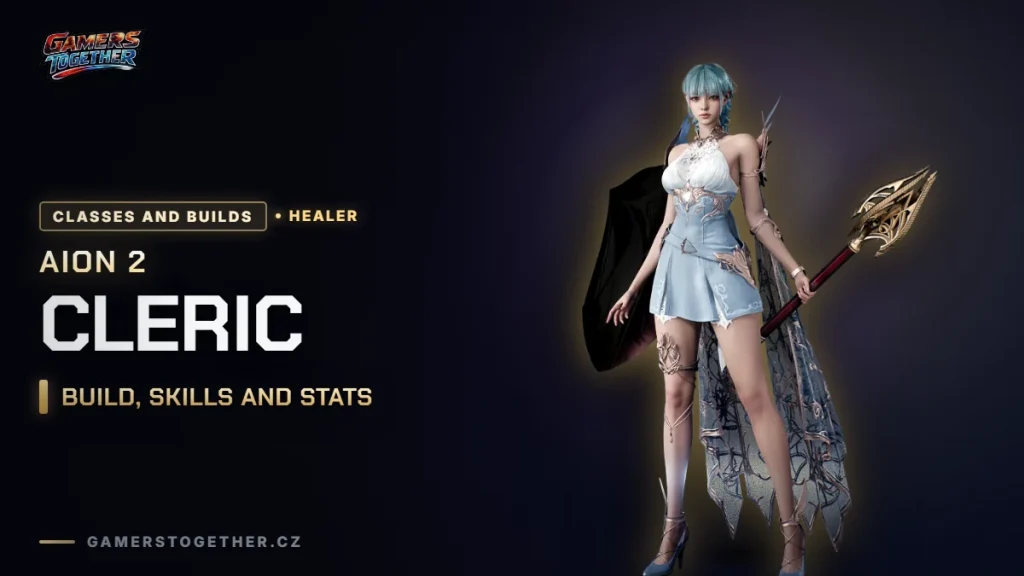
The Cleric is the main healer class in AION 2 and one of the eight classes the global version launches with. It fights with a Mace, heals the whole group at once instead of a single target, shields allies and is the only class that can resurrect a fallen player. On top of healing, it has its own offensive spells based on the earth and wind elements, so it is not a passive role. This guide covers AION 2, not the original AION from 2009.
Before you start reading the numbers: every specific value in this article comes from the Korean and Taiwanese versions of the game, or from an in-development game build. The global version enters early access on 30 September 2026 for Founder’s Pack owners and launches fully for everyone on 5 October 2026. Until then, NCSOFT has not published its own numbers, and the balance may differ.
The key points in five bullets
- The Cleric is the main healer (a class whose main job is restoring allies’ health) and one of the eight classes in the global version. The ninth, the Brawler, was added to the Korean and Taiwanese version by the Chapter 1 update on 1 July 2026 and will come to the global version later.
- The weapon is a Mace. According to a game data dump, it has 29 active and 10 passive skills, 39 in total, as of 31 July 2026.
- It heals in an area and preventively, not reactively. Its strength lies in shields, healing zones and healing over time, not in one big rescue spell on a single target.
- It is not a passive class. It has its own offensive kit, and one of its attack chains restores mana, so attacking is part of the job, not a side activity.
- The most similar class is the Chanter, and the difference between them is fundamental: the Cleric is a healer who sometimes attacks, the Chanter is a fighter who also heals. The full comparison is further down in the article.
Who the Cleric is in AION 2 and what role it plays
The Cleric is the main healer class in AION 2. It fights with a Mace, heals the whole group at once and is the only class that can resurrect a fallen ally. Resurrection is exactly what makes it a near-mandatory pick for dungeons and any coordinated fight: without it, the group has to start over after the first death. A Cleric heals the team in the game – and you can back AION 2 the same way with AION 2 merch from the GamersTogether shop.
The Cleric is one of the eight classes the global version of AION 2 launches with, alongside the Templar, Gladiator, Assassin, Ranger, Sorcerer, Spiritmaster and Chanter. The ninth class, the Brawler, is the newest; the Chapter 1 update added it to the Korean and Taiwanese version on 1 July 2026, and it will come to the global version later. We rank all the classes in our class overview and tier list.
Watch out for Cleric sources from 2009. The original AION also had a healer class of the same name, but its mechanics differ from AION 2. The image block in search results for “aion 2 cleric” shows the wikis aion.fandom.com and ign.com, and both describe a different game. How the sequel differs from the original is summed up in the article AION Classic vs AION 2.
Class choice in AION 2 is not tied to a faction. You can play a Cleric as Elyos or as Asmodian; the difference is where you start and who you will face. We cover the differences between the two sides in the article on the Elyos and Asmodian factions.
The Cleric in a group: who keeps whom alive
After the Chapter 1 update, a group in AION 2 has five slots, and the typical setup is a tank, a healer and three damage dealers. The Cleric and the tank form the pair that decides whether a fight is won: the tank decides where the hits land, the healer decides how long the group can take them.
What tanking involves and why the Cleric depends so much on a good tank is covered in the Templar guide, whose tanking section serves as the reference definition of the role across the whole guide series. For the Cleric, one practical point follows from it: if the tank doesn’t turn the boss away from the group and doesn’t keep enemies bunched together, area healing loses most of its value, because there is no cluster of players to hit at once.
How the Cleric heals: area, not single target
The Cleric is the game’s main healer, and yet its single-target healing will disappoint you. Both are true at the same time, and it is the most common misunderstanding about this class. The Cleric primarily heals in an area, meaning all allies within range at once, and the price for that breadth is a weaker individual heal.
The contradiction comes from the very sources that write about the Cleric the most:
| Source | What it says | Date |
|---|---|---|
| Fextralife wiki | The Cleric is the main healer class and the only one that can actively remove negative effects | 6 February 2026 |
| Fextralife wiki, two sections further down | Because of how wide its area healing is, its overall healing power is lower than you would expect from a full healer | 6 February 2026 |
| Fextralife, summary of test feedback | Feedback points toward an emphasis on area healing instead of reactive single-target support | 6 February 2026 |
| u4gm.com | Burst healing on a single target is not the Cleric’s strength; if allies ignore mechanics and rely on you to fix their mistakes, they will die | 11 November 2025 |
The explanation that turns those claims into one coherent picture: the Cleric doesn’t rescue, the Cleric prevents. If you expect a big rescue spell for a single dying player, you will be disappointed. If you get used to shielding before the hit lands, you get the strongest healer in the game.
The second thing to understand right from the start is charging. Several of the Cleric’s spells can be held down and charged, which increases both their effect and their range; the Sorcerer works on the same principle. Charging costs mana (MP, the resource you pay for spells with) and above all time, so panic charging is the most common mistake new healers make.
The third thing is movement. The Cleric has to dodge area attacks just like everyone else. Healing alone is not enough, and a healer standing still is a dead healer. How much the gameplay changes depending on your control scheme is covered in the article on the combat system: in Action Mode you really have to aim at your targets, while in Classic Mode you keep a better overview of your surroundings.
Key Cleric skills
According to a game data dump, the Cleric has 29 active and 10 passive skills, 39 in total (as of 31 July 2026). It is not a class with long rotations; what matters is the order and timing of a handful of abilities.
One important caveat about the names. English skill names vary between sources, because they come from different client versions and translations; across public sources there are three to four inconsistent sets. The names below are based on two independent listings (a direct game data dump from 1 January 2026 and a wiki from 6 February 2026) and may be different in the global client.
| Group | Skills |
|---|---|
| Healing | Healing Light (charged), Healing Light (Follow-Up), Radiant Recovery (charged), Light of Regeneration (healing over time for the whole group), Summon: Holy Breath (stationary healing zone) |
| Protection | Immortal Curtain (a shield, meaning a barrier that absorbs damage before it reduces health), Rescue (emergency area restore), Defiance → Blessing of Regeneration (removes stun and knockdown) |
| Attack | Earth’s Retribution → Thunder and Lightning → Discharge (basic attack chain that restores mana), Judgment Thunder → Divine Punishment (wind area damage), Chain of Torment (damage over time plus reduced earth resistance), Condemnation, Debilitating Mark, Bolt, Lightning Strike Scattershot |
| Stigma (optional) | Reincarnating Touch, Summon Resurrection, Healing Aura, Absolution, Salvation, Light of Protection, Yustiel’s Power, Prayer of Amplification, Root, Voice of Doom, Power Burst, Earth Punishment, Assault Mark |
Stigma is the system of optional skills a character uses to customize its ability set. We cover it in detail in the Stigma system guide, which is the shared foundation of all the class guides. Here too, this is AION 2, not the system of the same name from the 2009 game.
Five skills that make the difference
- Healing Light: your core heal. Charging increases both its power and its range. At full charge it also removes one negative effect from you and your allies, and while charging it gives the healer a shield of its own. In the calmer phases of a fight, this is your main tool.
- Immortal Curtain: the shield. It can be upgraded into a shorter but much stronger version. You use it before a big hit, not after, and that is the most important habit of the whole class.
- Summon: Holy Breath: the healing zone. A stationary zone that heals every few seconds for half a minute. The answer for phases where the group takes steady damage and nobody has to move.
- Rescue: the panic button. It restores half of maximum health and mana and clears all negative effects in a wide radius. Save it for the moment when the whole group is about to go down.
- Earth’s Retribution: the attack chain that restores mana. This answers the question of why a Cleric attacks between heals: it’s not about damage, it’s the Cleric’s source of mana. A healer who just stands there watching allies’ health bars won’t refill mana in a long fight.
One thing the sources can’t answer is resurrection. All sources agree that the Cleric can resurrect a fallen ally. Where they disagree is how exactly the ability is unlocked: one wiki lists it as a follow-up effect of the upgraded Immortal Curtain shield, while the game data dump lists it as a separate optional Stigma skill, Summon Resurrection. The difference is practical: either every Cleric has it automatically, or it costs one Stigma slot.
Specific values of the five core skills (Korean and Taiwanese versions)
The values in the table come from the Korean and Taiwanese versions and from an in-development game build. NCSOFT has not confirmed them for the global version. The source wiki says so itself next to its table: the skills are translated from a work-in-progress build of the game, so the information may be mistranslated or change. The most extensive text guide circulating online copied this table word for word, but left out the warning.
| Skill | What it does | Values (KR/TW, in-development build) |
|---|---|---|
| Healing Light | Charged area heal | 1,810–2,530 health, range 10–20 m depending on charge time |
| Healing Light (Follow-Up) | Follow-up heal | 1,180 health in a 20 m radius; upgrade to 1,928 in a 10 m radius, or conversion to 418 health every 2 s for 10 s |
| Immortal Curtain | Shield | Absorbs 3,580 damage for 10 s; upgrade to 6,200 for 5 s |
| Rescue | Emergency restore | 50% of maximum health and mana plus removal of all negative effects, 40 m radius |
| Summon: Holy Breath | Healing zone | 30 s duration, 625 health every 3 s in a 10 m radius (upgrade to 15 m) |
Recommended stats and gear
The stat priorities below come from the only source that lists them at all. They are one guide’s recommendation, not community consensus. They do fit how the class is built, though, and we include them precisely because no other public reference exists yet.
- Healing bonus. The core identity of the class and the only stat that boosts everything the Cleric does. It is also supported by the passive skills Healing Enhancement and Radiant Benediction.
- Mana cost reduction and mana regeneration. The Cleric is mana-hungry in long fights. This ties into Earth’s Retribution, which restores mana, but the attack chain alone isn’t enough to cover the cost.
- Shield strength. It prevents deaths before healing is even needed, which fits the preventive nature of the class exactly.
- Removing negative effects. In harder group content this isn’t a bonus but a requirement: some boss mechanics can only be handled by removing the effect, not by healing through it.
- Health and defense. The Cleric has the passives Immortal Veil (defense and critical hit resistance) and Prayer of Concentration (a shield below half health), so investing in survivability isn’t wasted.
And one specific recommendation on what not to do: don’t try to build the Cleric for single-target healing. The class isn’t designed for it, and you’ll end up with a healer that is weak at both.
No verifiable source has best-in-slot gear for the global version yet, and there’s no point guessing: the game hasn’t launched and nobody has seen the items. How gear is upgraded in AION 2 and where the line between safe and risky upgrades lies is covered in the article on enchanting and gear upgrades.
PvE build and rotation
The basic principle: group positioning decides the outcome more than the healer’s stats. The Cleric’s strongest healing is area-based, so a spread-out group wastes even a perfectly geared healer. If your allies refuse to stack up, no build will fix that.
Ability order in a boss fight, reconstructed from the Korean and Taiwanese versions:
- Immortal Curtain before a telegraphed big hit. The shield is a proactive tool; after the hit it’s useless.
- Summon: Holy Breath for phases with steady damage, ideally where the group is standing still anyway.
- Charge Healing Light only during calm moments. Panic charging wastes time a healer doesn’t have.
- In between, Earth’s Retribution to refill mana and Judgment Thunder for damage. The Cleric has plenty to do between heals.
- Rescue only as the last safety net: for mass negative effects, for the boss’s ultimate, or when the whole group is about to go down.
The value of an area healer went up after Chapter 1, for purely mechanical reasons. On the Korean and Taiwanese versions, group size increased from four to five players, and Sanctuary content takes ten players. The more people stand within healing range, the bigger the gap between an area healer and a single-target healer. The dungeon overview shows where exactly this comes into play.
PvP build: how to keep the Cleric alive
In PvP, the Cleric is target number one. Its job is not to kill but to survive longer than the enemy’s patience or cooldowns last. Every experienced enemy group goes for the healer first, and the whole build reflects that.
There are three survival tools. The Stigma skill Salvation cancels incoming damage and resists new negative effects, although some of the strongest attacks can’t be stopped with it. Defiance frees you from stuns, knockdowns and knock-ups. And the Stigma skill Reincarnating Touch lets you resurrect yourself with half your health and mana after death. In open PvP, that’s the difference between “I have to walk back for two minutes” and “I’m back in the fight”.
On the offensive side, three abilities make the most sense in PvP: Root to immobilize, Voice of Doom, which reduces the enemy’s healing effectiveness, and the passive Heal Block, which has a chance to reduce the opponent’s incoming healing when you attack. Reducing enemy healing is key in a duel against another healer, and it’s a detail that competing Cleric guides leave out.
The main threat to the Cleric is the Assassin, a class built precisely to reach the back line. The environment where group PvP takes place is covered in the article on the Abyss.
Context you need to read the PvP numbers: the 25 March 2026 update separated damage calculation for PvP and PvE and added precisely timed defense, and the 8 July 2026 update then cut PvP damage across the board by 30 percent. Longer fights favor classes with staying power, which includes the Cleric. Both changes, however, happened on the Korean and Taiwanese versions and are not confirmed for the global launch.
What the Chapter 1 balance changes brought the Cleric (Korean and Taiwanese versions)
The “Chapter 1. Lands of Sand and Snow” update was released on 1 July 2026, and it wasn’t just about adding a new class: it brought a full balance pass for all eight original classes. The complete content summary is in the Chapter 1 patch notes overview.
| Change | Detail | Source and date |
|---|---|---|
| New Stigma skill Reincarnating Touch | Added with the stated aim of emphasizing each class’s unique identity; allows self-resurrection with half health and mana | NCSOFT, 25 March 2026 |
| Stigma slots from four to five | Applies to all classes; slots are shared with Mastery | NCSOFT, 25 March 2026 |
| Maximum Stigma level from 20 to 25 | Via advanced Stigma Shards | NCSOFT, 6 July 2026 |
| Separate PvP and PvE damage | Tuning one part of the game no longer breaks the other, which is crucial for healers | NCSOFT, 25 March 2026 |
| Group size from four to five, Sanctuary to ten | Direct impact on the value of an area healer | NCSOFT, 6 July 2026 |
| Maximum character level from 45 to 50 | Applies to the Korean and Taiwanese versions | NCSOFT, 6 July 2026 |
Mandatory caveat: all these changes happened on the Korean and Taiwanese versions. The global version hasn’t published its own patch notes, and NCSOFT hasn’t confirmed what will carry over. If you tried the Cleric on a Taiwanese server in fall 2025, since March you have one extra Stigma slot and a new skill on top, so rebuilding is worth it.
Is the Cleric good for beginners?
Yes. Of the healer classes, the Cleric is the more straightforward one. A summary of feedback from the game’s testing describes it as a class that is accessible even for solo players, with good area damage and simple healing: almost no long casts and no switching between combat stances. For a beginner, that’s a big relief. The controls don’t demand mechanical skill, just attention.
Player discussions offer a more sober counterpoint: the damage is usable for solo play and the healing is good, but far from exceptional. You can get by solo with a Cleric, it just takes longer than with a damage class. The discussion also dates from fall 2025, before two balance passes, so it describes a different game balance than the one you’ll find today.
The honest summary: the Cleric is easy to control but demanding in terms of responsibility. A healer’s mistake is more visible than a damage dealer’s: when a damage dealer slips up, the damage dealer dies; when the healer slips up, the group dies. If that doesn’t bother you, you get one of the most rewarding classes in the game. For a broader comparison, including which classes to avoid at the start, see the article which class is best for beginners.
Cleric vs. Chanter: two healing classes, two different roles
This is the most common real decision for anyone who wants to play support in AION 2. Both classes are listed as priests, both can restore health and the two get mixed up all the time. The table below is the only place in our entire guide series where the difference between them is laid out in full. The Chanter guide links here.
| Cleric | Chanter | |
|---|---|---|
| Weapon | Mace | Staff |
| Role according to game data | Healer | Healer / DPS |
| Role according to skill database | Healer | Support / Healer |
| Where it stands in a fight | In the back line | In the front line, among enemies |
| How it helps the group | Heals and shields | Buffs allies with permanent auras (mantras) and tops up health |
| Resurrecting the fallen | Yes | No |
| Removing negative effects | Yes, actively | Limited |
| Own damage | Supplementary, magical (earth and wind) | Significant, physical, in melee |
| Solo play | Usable | Strong, according to testers |
| Skill count (game data) | 29 active + 10 passive | 33 active + 10 passive |
| Typical player | “I want to keep the group alive” | “I want to help, but also hit things” |
The decision rule in one sentence: the Cleric is a healer who sometimes attacks, the Chanter is a fighter who also heals. In a group they don’t exclude each other: on Korean servers, a common setup is two damage dealers, a Cleric and a Chanter. The full breakdown of the other class is in the Chanter guide, and where both rank among all the classes is in the class overview and tier list.
One note on the name: one community site lists a second name for the Chanter, Guardian Sage. It’s an unverified variant that no official material confirms. If you come across it, it describes the same class.
What we’ll add after the global launch
Seven open questions remain for the Cleric, and all of them can only be settled in the game itself. They are: the armor type it wears; how exactly resurrection is unlocked; the English skill names from the global client; confirmation of the skill count; the actual healing numbers after both balance passes; best-in-slot gear; and the Cleric’s placement in the first tier list, which won’t exist until after the global balance patch.
The checkpoints are 30 September 2026, when early access opens for Founder’s Pack owners, and 5 October 2026, when the game launches for everyone. Until then, treat the specific values as a guideline.
Ping spikes in AION 2? Code MAGIC takes 62% off LagoFast.
LagoFast is a game booster that optimises the route to the game server. After registering you get 4 hours free, so you can check whether it helps on your server before paying – and the code MAGIC gets you 62% off your first order. Step by step in our LagoFast guide, or try it with the discount.This is an affiliate link. If you buy through it, GamersTogether earns a commission. It doesn’t affect your price or what we write here.
FAQ
The Cleric is the main healer class in AION 2 and one of the eight classes in the global version. It fights with a Mace, heals the whole group at once in an area, shields allies, actively removes negative effects and is the only class that can resurrect a fallen player. It also has its own offensive spells based on the earth and wind elements, so in combat it doesn’t rely on healing alone.
In PvE, build around shields before telegraphed hits, a healing zone for phases with steady damage and charged healing during calmer stretches. In PvP it’s mainly about survival: self-resurrection, canceling incoming damage and reducing the enemy’s healing. Both are based on the Korean and Taiwanese versions and are not confirmed for the global launch.
Yes. Healing doesn’t require switching combat stances or long casts, so you’ll get the hang of the controls quickly. What’s demanding about the Cleric is responsibility, not difficulty: a healer’s mistake costs the whole group their lives, while a damage dealer’s mistake only costs their own. If you can handle that, you get a class that groups are always looking for.
The Cleric is a back-line healer with a Mace, area healing, shields and resurrection. The Chanter is a front-line support with a Staff that buffs allies with permanent auras, deals significant melee damage itself and only supplements healing. The Chanter can’t resurrect fallen allies. The full comparison of both classes is in the table above in this article.
Yes, it’s the Cleric’s signature ability and no other class has it. Public sources disagree, however, on how exactly it is unlocked: one wiki lists it as a follow-up effect of the upgraded shield, the game data dump as a separate Stigma skill. The difference is practical and will only be settled in the global client.
Yes. The Cleric is one of the eight classes the global version launches with: early access on 30 September 2026, full free-to-play launch on 5 October 2026.
The Cleric is a class whose value isn’t measured by its own numbers, but by whether the group makes it to the end. After early access starts on 30 September and again after the full release on 5 October 2026, we’ll go through this guide again and update it with the actual skills, values and stat distribution straight from the game. You’ll find all the other guides in the AION 2 guides section. Information verified as of 14 August 2026.
Healing under pressure is a macro problem as much as a skill problem. We cover it in the AION 2 macro guide, and the board itself in the Daevanion guide.