
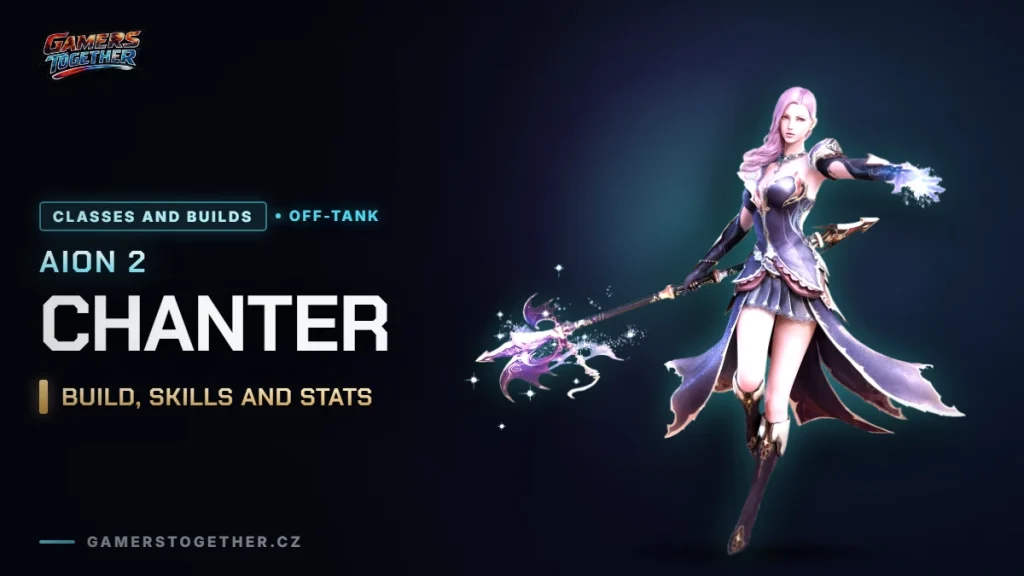
The Chanter is the hybrid support of AION 2 and one of the eight classes the global version launches with. It fights on the front line with a Staff, buffs the whole group with permanently running auras called mantras and keeps topping up their health. It isn’t the main healer; that’s the Cleric’s job. But it’s the only class that buffs the group, heals it and deals damage at the same time. This guide covers AION 2, not the original AION from 2009.
Before you read the specific recommendations: the skills, mantras and builds in this article come from the Korean and Taiwanese versions of the game or from a build still in development. The global version enters early access on 30 September 2026 for Founder’s Pack owners and launches fully for everyone on 5 October 2026. Until then, NCSOFT hasn’t published its own numbers, and class balance may differ.
The essentials in five points
- The Chanter is a hybrid support and one of the eight classes in the global version of AION 2. The ninth, the Brawler, was added to the Korean and Taiwanese version by the Chapter 1 update on 1 July 2026 and will come to the global version later.
- Its weapon is a staff, which works both as a melee weapon and as a focus for spells. According to a game data dump, it has 33 active and 10 passive skills, 43 in total, as of 31 July 2026.
- It isn’t a healer (a class whose main task is restoring teammates’ health). It’s a front-line fighter that provides steady area healing. If you expect big clutch heals from it, you’ve picked the wrong class.
- Its identity is the mantras: auras you switch on that keep running until you switch them off. According to game data, they’re optional Stigma skills, not an automatic part of the class kit.
- Solo, the Chanter is strong because it has both damage and self-healing. In a group it’s more demanding, and that’s where the most common question about this class comes from. We answer it in the very next section.
Is the Chanter any good in AION 2? The short answer
Yes. The Chanter is rated as a strong solo class and is a regular part of the lineup in Korean group runs; it just does something different from what you expect of a support. Doubts about it almost always arise the same way: players measure it against a healer. As a healer, the Chanter is average. As the fifth group member who adds auras, tops up health and still deals damage, it has the best utility ratio in the game.
This isn’t just an impression. It’s what public sources consistently say about the class:
| Source | How it rates the class | Date |
|---|---|---|
| Fextralife – summary of test feedback | Testers described the Chanter as a hybrid healer with high damage and strong self-sustain; in their view it’s great for solo play precisely because it combines damage and healing | 6 February 2026 |
| Player discussion about the class’s usefulness | Top-rated reply: the poster’s safest and fastest runs were with a lineup of two damage dealers, a Cleric and a Chanter | ~December 2025 |
| Game data aggregator | Never the main healer, yet it keeps the group alive and adds real damage; it does well in solo play and as a supplementary raid pick | 31 July 2026 |
| Community video on the class | The latest assessment before the global launch, clearly positive | 24 July 2026 |
One mechanical argument you won’t find in any other guide: the Chapter 1 update increased the party size from four to five players. In a four-player party, the Chanter competed with the main healer for a spot. In a five-player party, there’s a free slot next to the healer for someone who buffs the group and also pulls their weight in combat, which is an exact description of this class.
That change, however, happened in the Korean and Taiwanese versions. NCSOFT hasn’t confirmed whether the global version will also launch with five-player parties.
Who the Chanter is and what role it plays
The Chanter is a support class that fights in melee with a staff and buffs the whole group with permanently running auras. The staff isn’t a caster’s prop. It’s a full-fledged melee weapon, and the Chanter uses it standing among enemies, not behind its teammates.
The Chanter is one of the eight classes the global version of AION 2 launches with, alongside the Templar, Gladiator, Assassin, Ranger, Sorcerer, Spiritmaster and Cleric. The ninth, Brawler, is the newest; the Chapter 1 update added it to the Korean and Taiwanese version on 1 July 2026, and it will come to the global version later. We look at where the Chanter ranks among the other classes in our class overview and tier list.
One community site lists the Chanter under an alternative name, Guardian Sage. It’s an unverified variant that no official NCSOFT material confirms. If you run into it in other guides, it describes the same class.
The fact that sources disagree on the Chanter’s role isn’t a mistake. It’s the definition of the class. One aggregator lists it as a healer with damage, a skill database as a support with healing, the most widely read guide as a hybrid support with damage, and the wiki says it handles several roles at once, from buffing through supplementary healing to damage. The Chanter is a class that fills whatever the group happens to be missing.
In a group it stands next to the tank, not behind it. The difference between the two roles is crucial: the tank deliberately draws enemy attention, the Chanter doesn’t. It just survives standing where the action is. What tanking actually involves and why the Chanter can’t replace it is covered in our Templar guide, whose tanking section serves as the reference definition of the role throughout this guide series.
Watch out for material about the original AION. A class with the same name existed in the 2009 game, but its skill set differs from AION 2. In Czech search results for “aion 2 chanter”, the wiki aion.fandom.com, which covers the original game, sits at the eighth organic position; in US search results for “aion 2 chanter build”, the entire image block consists of screenshots from “Aion 4.0” from 2012 and the discussions block contains a thread from 2010. How the sequel differs from the original is summed up in the article AION Classic vs AION 2.
Class choice in AION 2 isn’t tied to faction, so you can play a Chanter as Elyos or as Asmodian. We break down the differences between the two sides in our article on the Elyos and Asmodian factions.
Mantras: what they are and how many you can have
Mantras are auras the Chanter switches on that keep running until it switches them off, buffing the Chanter and all nearby teammates. They’re so-called toggle skills, abilities with an on and off state, not one-off spells. And they’re exactly where public sources disagree the most.
| Source | What it says about mantras | Date |
|---|---|---|
| The most widely read text guide | The Chanter has four mantras, three of them “permanent”, and should keep them on practically all the time; in PvE it recommends running three at once | 11 November 2025 |
| Direct game data dump | Mantras are listed as Stigma skills, meaning optional abilities competing for a limited number of slots | 1 January 2026 |
| NCSOFT (official) | Maximum number of Stigma slots expanded to five; the slots are also shared with Mastery skills | 25 March 2026 |
The takeaway: if you’ve come across the advice “keep three mantras on at all times”, take it with caution. According to game data, mantras are optional Stigma skills that compete with other abilities for slots, so you have to choose, and choosing your mantras is really the core of the whole build. How many can run at the same time isn’t confirmed by public sources.
Stigma is a system of optional skills that lets your character customize its skill set. We cover it in the Stigma system article, which is the common foundation for all class guides. For the Chanter, that article is required reading more than for any other class: its identity rests on the Stigma slots. Here too, this is about AION 2, not the system of the same name from the 2009 game.
Here’s an overview of the auras and similar abilities according to the game data dump:
| Skill | What it does | Type |
|---|---|---|
| Undefeated Mantra | Increases damage and damage resistance for the player and the whole group | Toggle aura |
| Sprint Mantra | Increases movement speed and gives a chance to restore health on hit | Toggle aura |
| Power of the Storm | Increases combat speed for the player and the group | No target required |
| Impeding Authority | Protective shield for the player and the group | No target required |
| Barrier Spell | Prevents the health of the player and the group from dropping below 10% | No target required, usable while moving |
| Healing Touch | Restores health to the player and the group | No target required, usable while moving |
| Guardian Blessing | Increases maximum health and restores part of it right away | No target required, usable while moving |
The second documented contradiction concerns the skill Power of the Storm. The text guide mentioned above describes it as an attack and critical hit bonus for the whole group, while the game data dump talks about combat speed. Those aren’t the same effects. In this article we work with the game data version because it comes straight from the client, but only the global version will give a definitive answer.
Barrier Spell deserves a separate mention. It’s a Stigma skill the Chanter received directly from NCSOFT on 25 March 2026, with the stated aim of emphasizing each class’s unique identity. A safety net that keeps the whole group’s health from dropping below a tenth is a crucial ability in boss fights and in group PvP, and none of the competing guides mention it, because they were all written earlier.
Key Chanter skills
According to the game data dump, the Chanter has 33 active and 10 passive skills, 43 in total (as of 31 July 2026). Among the Cleric, the Chanter and the Brawler, that’s the broadest skill set.
One caveat about names that you need to take seriously. The English skill names differ between sources: across public materials there are three to four inconsistent sets. The most widely read text guide uses the names Strike Chain, Ascendant Strike, Healing Wave and Mantra of Valor, but none of them appears in the direct game data dump. It’s either an older build or a loose translation. The names below are therefore based on the game data dump and the skill database, not on guides, and the skills may have different names in the global client.
| Group | Skills |
|---|---|
| Basic attacks (chain) | Onslaught → Resonance Crush → Bolt Crush (damage to multiple enemies, restores mana), Incandescent Blow → Bursting Blow |
| Gap closers and area damage | Rushing Smash (charge at the target), Spinning Strike (area in front of the player), Heat Wave Blow |
| Crowd control | Impactful Crush (chance to stun, guaranteed on regular enemies), Tremor Crush (moves to the target and stuns after a dodge), Wave Blow (knocks a stunned target down) |
| Follow-up damage | Dark Crush (on stunned, knocked-down or airborne targets), Gust Rampage (on staggered targets) |
| Support and defense | Recuperation (instant and over-time health restoration for the group), Defiance → Crushing Strike (breaks free of stun and knockdown, then counterattacks with a stun) |
| Stigma (optional) | Barrier Spell, Undefeated Mantra, Sprint Mantra, Power of the Storm, Impeding Authority, Healing Touch, Guardian Blessing, Focused Defense, Obliterate, Fracturing Blow, Marchutan’s Wrath, Ensnaring Mark, Assault Shock |
| Passive | Blessing of Life, Crossguard, Protection Circle, Inspiring Spell, Attack Preparation, Impact Hit, Raging Spell, Earth’s Promise, Survival Willpower, Wind’s Promise |
Four abilities that make the difference
- Onslaught and its chain: the core of the rotation. Besides damage, it restores mana (MP, the resource that pays for abilities), which lets the Chanter keep auras and healing going without a break. Stop attacking and you stop having anything to support with.
- Impactful Crush → Dark Crush → Wave Blow: the control chain. Stun, punish the stunned target, knock it down. This is the Chanter’s main PvP tool and also the main reason it pays to stand on the front line.
- Recuperation: the only heal outside the Stigma slots. It combines an instant heal with a heal over time, so you use it preemptively, not as a last-second save. If you wait until someone is in danger, you’re using it wrong.
- Protection Circle: quietly the strongest ability of the class. Every hit adds a charge, and at ten charges the player and the whole group get a protective barrier. That means the Chanter protects the group by attacking, and that’s the whole logic of this class. None of the competing guides mention it.
You won’t find specific damage numbers or cooldown lengths in this article, because no verifiable source lists them yet. There’s no point in guessing. How much the gameplay changes depending on your control scheme is covered in our article on the combat system: in action mode you have to actually aim at targets, in classic mode you keep better track of your surroundings, and for a class that manages auras and its own positioning, that’s an important decision.
Recommended stats and gear
The stat priorities below come from the only public source that lists them at all, so they’re one guide’s recommendation, not a community consensus. They are, however, backed by passive skills from the game data, so they’re not guesswork.
- Critical hit and accuracy. The Chanter needs a steady flow of damage to sustain mana and barrier charges. This is supported by the passives Inspiring Spell (increases critical hit) and Wind’s Promise (bonus damage on critical hits).
- Health and defense. You fight within enemy reach, so survivability isn’t a luxury. The passives Blessing of Life (maximum health) and Crossguard (block and health restoration on block) confirm this.
- Healing bonus. It scales the continuous health restoration, the part of the Chanter’s work the group notices first.
- Block. Thanks to Crossguard and the Stigma skill Focused Defense, which temporarily increases damage reduction when blocking from the front and guarantees a deflect, this is a full-fledged stat path, not a niche one.
The advice for a new Chanter is simple: survivability first, damage second. A dead Chanter gives the group no auras, and turning mantras back on after dying costs time you don’t have in combat.
No verifiable source has best-in-slot gear for the global version yet, and there’s no point in making it up: the game isn’t out and nobody has seen the items. How gear upgrading works in AION 2 and where safe upgrading ends is explained in the article on enchanting and gear upgrades.
Three Chanter builds: solo, group PvE and PvP
The setups below are reconstructed from the only guide that lays them out at all, supplemented with skills from the game data dump. They apply to the Korean and Taiwanese versions and are our editorial recommendations, not the official meta.
| Build | What it’s for | Skill priorities | Stat priorities |
|---|---|---|---|
| Solo and leveling | Fast progress without a group | Onslaught chain for mana, Rushing Smash to close the gap, Impactful Crush to stun, Recuperation to top up health; from Stigma, Sprint Mantra and Undefeated Mantra | Critical hit, health |
| Group PvE | Dungeons and bosses | Keep auras up for the group, Impeding Authority before a telegraphed big hit, Healing Touch continuously, Barrier Spell as insurance against a group wipe | Healing bonus, defense, block |
| PvP and front line | Arenas and the Abyss | Control chain Impactful Crush → Dark Crush → Wave Blow, Defiance against enemy crowd control, Power of the Storm for combat speed | Accuracy, status effect resistance, health |
A universal principle that applies to all three setups: the Chanter gets stronger the closer it is to its teammates. Its value isn’t in its own numbers but in its distance from the group. If you go off on your own in the middle of group content, you’re playing a weaker class than the one you actually have.
On top of that, three practical rules you won’t find elsewhere. First: don’t spam heals on individuals; use area heals when the group bunches up. Second: turn your auras back on after every death, otherwise the group fights without them and nobody notices right away. And third: in PvP, the timing of your crowd control matters more than damage.
Where group PvP takes place and how its rewards work is covered in our article on the Abyss. The setting for the group PvE build is in our dungeon overview, and that’s exactly where you’ll find out whether a five-player group leaves room for a hybrid or not.
What the Chapter 1 balance changes brought the Chanter (Korean and Taiwanese versions)
The “Chapter 1. Lands of Sand and Snow” update came out on 1 July 2026 and wasn’t just about adding a new class. It brought a complete balance pass for all eight original classes. The full summary of its content is in our Chapter 1 patch notes overview. None of the competing Chanter guides have this section, because they were all written before it.
| Change | What it means for the Chanter | Source and date |
|---|---|---|
| New Stigma skill Barrier Spell | Prevents the health of the player and the group from dropping below 10%; NCSOFT added it with the stated aim of emphasizing each class’s unique identity | NCSOFT, 25 March 2026 |
| Stigma slots increased from four to five | Directly affects how many mantras the Chanter can keep running; the slots are shared with Mastery | NCSOFT, 25 March 2026 |
| New defensive mechanics Perfect Shield Block and Perfect Parry | A block-focused Chanter benefits from them more than most | NCSOFT, 25 March 2026 |
| Separate PvP and PvE damage | Tuning one part of the game no longer breaks the other, which matters twice as much for a hybrid class | NCSOFT, 25 March 2026 |
| Maximum Stigma level raised from 20 to 25 | Via advanced Stigma Shards; stronger mantras for the same number of slots | NCSOFT, 6 July 2026 |
| Party size increased from four to five, Sanctuary to ten | The most important change for the Chanter: a five-player group has room for a hybrid next to the main healer | NCSOFT, 6 July 2026 |
| Maximum character level raised from 45 to 50 | Applies to the Korean and Taiwanese versions | NCSOFT, 6 July 2026 |
| Across-the-board 30% reduction in PvP damage | Longer fights favor classes with sustain, including the Chanter | Korean update notes, 8 July 2026 |
Mandatory caveat: all of these changes happened in the Korean and Taiwanese versions. The global version hasn’t published its own patch notes, and NCSOFT hasn’t confirmed what will carry over to it. If you tried the Chanter on a Taiwanese server in fall 2025, since March you’ve had one extra Stigma slot and one new safeguard against a group wipe, so it’s worth rebuilding your setup.
Chanter or Cleric? The difference in one paragraph
Both classes are listed as priests, both restore health and both regularly get mixed up. From the Chanter’s point of view, though, the difference is simple: the Cleric is a healer who sometimes attacks, the Chanter is a fighter who also heals. The Chanter stands on the front line with a staff, buffs teammates with permanent auras and deals significant physical damage; the Cleric stands at the back with a mace, heals and shields, actively removes negative effects and is the only class that can resurrect a fallen player. Don’t expect resurrection or full-fledged debuff removal (removing negative effects placed on players) from the Chanter. In a group, though, the two don’t exclude each other: on Korean servers a lineup of two damage dealers, a Cleric and a Chanter is common. You’ll find a complete point-by-point comparison of both classes, including weapons, skill counts and the typical player, in our Cleric guide. It’s the only place in the entire guide series where the difference is laid out in full, and we deliberately don’t duplicate it.
Is the Chanter good for beginners?
For solo play yes, for group content it’s better suited as your second class. The summary of feedback from game testing describes the Chanter as a great class for solo progression thanks to its combination of high damage and self-healing, with strong self-sustain. A beginner playing it won’t die as often and doesn’t have to wait for a group to move forward.
The counterweight is concrete, though. The most widely read guide explicitly warns that the complexity of the rotation (the order in which you use skills) grows at higher levels, and the Chanter lacks a big instant heal, which you’ll notice in a dungeon sooner than while leveling. On top of that, it has to handle two things at once: watch its running auras while fighting within enemy reach. That’s one task more than a pure damage class has. A Chanter supports the team with songs – and you can support AION 2 the same way with AION 2 merch from the GamersTogether shop.
An honest summary: the Chanter is forgiving while leveling and demanding in a group. The exact opposite of the Templar, which is demanding at first and rewarding later. If that suits you, you get a class that always has a place in groups. For a broader comparison, including which classes to avoid at the start, see our article which class is best for beginners.
What we’ll add after the global launch
Eight open questions remain for the Chanter, and all of them can only be settled in the game itself. They are: how many mantras can run at the same time; whether “Guardian Sage” really is a second name for the class; what armor type the Chanter wears; the English skill names from the global client; specific damage and healing numbers; the actual effect of the skill Power of the Storm; best-in-slot gear; and the Chanter’s placement in the first tier list, which will only be made after the global balance patch.
The checkpoints are 30 September 2026, when early access opens for Founder’s Pack owners, and 5 October 2026, when the game launches for everyone. Until then, treat the specific recommendations as a rough guide.
Ping spikes in AION 2? Code MAGIC takes 62% off LagoFast.
LagoFast is a game booster that optimises the route to the game server. After registering you get 4 hours free, so you can check whether it helps on your server before paying – and the code MAGIC gets you 62% off your first order. Step by step in our LagoFast guide, or try it with the discount.This is an affiliate link. If you buy through it, GamersTogether earns a commission. It doesn’t affect your price or what we write here.
FAQ
Yes. The Chanter is rated as a strong solo class and is a regular part of the lineup in Korean group runs. Doubts about it arise when it’s measured against a healer, a role in which it’s average. Its value lies in buffing the group, topping up its health and fighting at the same time. A five-player group has room for a class like that.
It depends on what you play. For solo, build around critical hit and health with speed and damage auras. For group PvE, go for healing bonus, defense and block, with a protective shield and insurance against a group wipe. For PvP, go for accuracy and resistance, with the control chain. All three setups are based on the Korean and Taiwanese versions.
Mantras are auras the Chanter switches on that keep running until it switches them off, buffing the Chanter and nearby teammates. According to the game data dump, they’re optional Stigma skills competing for a limited number of slots, so you have to choose. The exact number of mantras that can run at the same time isn’t confirmed by public sources.
The Chanter is a front-line support with a staff: it buffs teammates with permanent auras, fights hard in melee and heals only as a supplement. The Cleric is a back-line healer with a mace who heals in an area, shields, removes negative effects and is the only class that can resurrect a fallen player. A complete point-by-point comparison is in our Cleric guide.
For solo play yes, in a group it’s more demanding. While leveling it forgives mistakes because it has both damage and self-healing and doesn’t need a party. In a dungeon, though, you have to watch your running auras while fighting in melee, and the Chanter has no big instant heal. It’s the opposite of the Templar, which is demanding at first and rewarding later.
Yes. The Chanter is one of the eight classes the global version launches with: early access on 30 September 2026, full free-to-play launch on 5 October 2026. The ninth class, the Brawler, was added to the Korean and Taiwanese version with the Chapter 1 update on 1 July 2026 and will come to the global version later.
The Chanter is a class whose value can’t be read from its own numbers; it only shows in how the whole group performs. After early access opens on 30 September and after the full release on 5 October 2026, we’ll go through this guide again and add the actual skills, mantras and values straight from the game; the exact launch dates are summed up in our article on the AION 2 release date. You’ll find all our other guides in the AION 2 guides section. Information verified as of 7 August 2026.
Buff uptime is where Chanters win or lose, which makes macros essential reading. The point spend itself is in the Daevanion guide.