
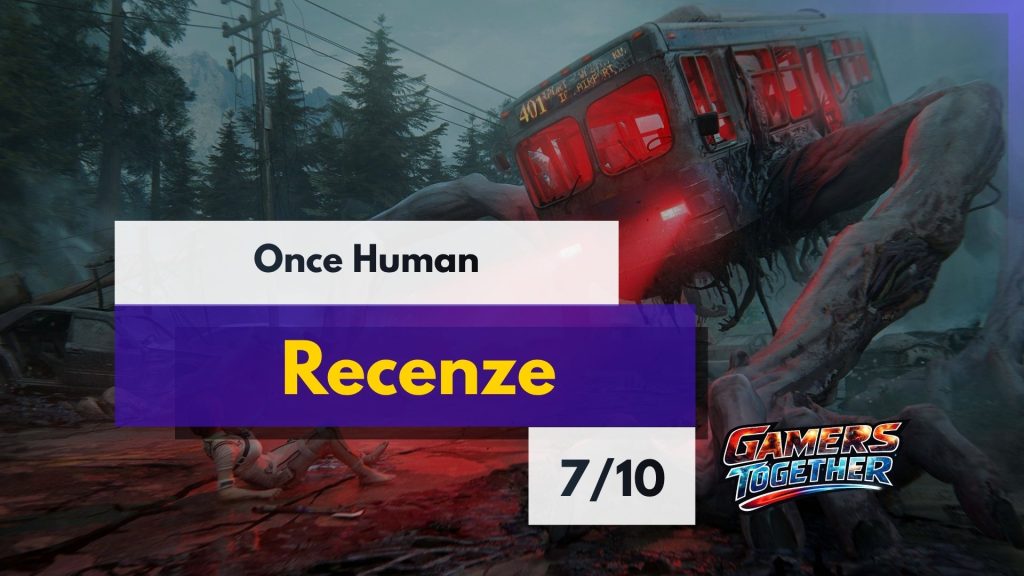
Once Human is easy to pigeonhole wrongly within seconds: “a new survival game, another MMO, another free-to-play title that’ll be dead in a year.” The reality is different. The game launched back on 9 July 2024, it’s free, it runs on PC, mobile and, since August 2026, on PlayStation 5 and Xbox too, and instead of one persistent world it’s built on recurring seasons called scenarios. Let’s be upfront: we haven’t played Once Human. The score in the card above and the whole text rest on Starry Studio’s official materials and verifiable data, not on impressions from our own playtime.
Review
Once Human
An honest free-to-play survival game with seasonal resets and collectible Deviants. The score is based on the developer’s official materials, not on our own playtime.
- Genre
- Survival MMO (free-to-play)
- Developer
- Starry Studio (NetEase Games)
- Release
- 9 July 2024 · consoles 25 August 2026
- Platforms
- PC, PS5, Xbox Series, Android, iOS
- Microtransactions
- Cosmetics and Battle Pass
What works
- Free-to-play with no paid power, you only buy looks
- Deviants and base automation keep working while you’re offline
- Active development with updates every few weeks
What doesn’t
- Seasonal server resets won’t suit everyone
- Gacha crates in the shop, even without gameplay advantages
- Long distances between objectives before your first vehicle
Assessed from the developer’s official materials and public sources · applies to version 3.0.5
What Once Human actually is
In the developers’ own words, Once Human is a “multiplayer open-world survival game”. That’s a quote straight from their official FAQ for the console version, not our interpretation. You explore a world hit by an unexplained catastrophe, build and defend a base, gather resources, capture mutated creatures called Deviants and join PvE and PvP content as you choose.
The game launched on PC and mobile on 9 July 2024 and has gone through a number of updates since. The current one is version 3.0.5 from 2 September 2026. The console version on PS5, PS5 Pro and Xbox Series X|S went live on 25 August 2026 with the same content and the same rules as the other platforms. Starry Studio, under the NetEase Games banner, is both the developer and the publisher, and the pace of updates reflects that. More on this in the section on the state of the game today.
The world and the mechanics that set it apart
Once Human’s atmosphere is body horror: mutated animals, deformed cities, strange phenomena across the landscape. The story isn’t the main focus. The game doesn’t rely on cinematic cutscenes but on how you react to a world that has fallen apart. There are plenty of survival games on PC and consoles, and most of them share the same foundation: gather, craft, build, defend. Once Human layers three mechanics on top of that foundation that make it stand out.
Deviants are mutated creatures you first meet as enemies, but once captured they serve as permanent companions. They come in combat types that fight alongside you, territorial types that work on your base automatically even while you’re offline, and companion types that are mostly cosmetic company. What also matters is the trait, a random property assigned to a specific Deviant when you capture it, not the species itself. The separate Deviants overview covers this in detail.
Territory automation means your base keeps running without you. Production Deviants and machines keep working while you’re offline, which makes Once Human a game you don’t have to play non-stop to feel like you’re progressing.
Scenarios are themed game variants with their own map, rules and pace that run on dedicated servers for a set length of time. This mechanic is the furthest from the survival genre standard and also the one that divides the community most, which is why it gets its own section.
The seasonal model: the biggest dividing line in the community
This is where opinions on Once Human split the most. It’s the only mechanic in the game where it makes sense to talk about two camps of players rather than one consensus.
Once Human doesn’t have one persistent world. Instead, you pick a scenario: for example PvE Manibus for newcomers, surviving the cold in The Way of Winter, the co-op Endless Dream, Deviant hunting in Deviation: Survive, Capture, Preserve, or one of the two PvP scenarios, Evolution’s Call and Prismverse’s Clash. Each scenario has phases that last anywhere from a few days to several dozen days, and when a scenario ends you have three options: stay on the server (after a 14-day rest phase it automatically merges into that scenario’s permanent server), sign up for a new scenario, or retreat to Eternaland, a permanent space that no reset ever wipes.
The word “wipe” that the community has adopted is a bit misleading. Cosmetics, most currencies, blueprints, recipes and quest progress carry over automatically no matter what you do. Weapons, armor, resources, medicine and Deviants go to Eternaland, and you take them back as needed through so-called Resource Inheritance Points. So it’s not a hard reset to zero but rather a managed transition where you spend “points” on what you want to carry over.
Even so, there’s a real reason people worry about it: even a managed transition means a specific server closes when the scenario ends, and whatever you spent hours building on it physically stays there. If you grow fond of a particular base and a server community, the end of a scenario will bother you no matter how much technically carries over. On the other hand, if you play Once Human precisely for the scenarios, because the world changes regularly and offers a fresh start, you’ll see the seasonal structure as an advantage, not a punishment.
You’ll find a detailed step-by-step breakdown of exactly what a wipe deletes and what you keep in our article on seasons, wipes and Eternaland. To decide whether Once Human is for you, this is enough: if you want one persistent world without repeated resets, the seasonal structure will bother you however softly it’s implemented. If you don’t mind regularly starting a new scenario and you like that the meta and the map keep changing, it’s a feature, not a bug.
Monetization: what’s free and whether it’s pay-to-win
Once Human has been free-to-play from the start on every platform, PC, mobile and consoles, and that includes all gameplay content: scenarios, dungeons, PvP and PvE. You don’t even need PlayStation Plus or Xbox Game Pass Core. Both only give you extra cosmetic bonuses.
Paid content consists of cosmetics, the Battle Pass and the Lightforge Loot Crate, themed “crates” you open with the Lightforge Ingot currency, bought with Crystgin (the premium currency). We went through dozens of the most recent waves of these crates using the official probability announcements, and without exception they contained only cosmetics: hairstyles, outfits, vehicle and weapon skins, base furniture, stickers and similar visual items. None of them included an item that raises damage, defense or any other combat stat. The crates also have a pity system, a guaranteed rarer reward after a fixed number of openings, so it isn’t a purely random pull with no ceiling.
In the official FAQ for the console version, the developers state literally that the game “is not pay-to-win”. That’s their own wording, not our assumption. Based on what the data on paid content shows, the claim holds up: you pay for looks, not for power. One thing still deserves a note, though. A gacha crate mechanic with tiered rarity can bother some people on its own, whatever is hidden behind it. That’s a matter of taste in monetization models as such, not a question of fairness toward players.
| What you buy | Does it affect character power? |
|---|---|
| Cosmetics, appearances, outfit dyeing | No |
| Battle Pass | No, it’s cosmetics and faster progress, not stats |
| Lightforge Loot Crate (gacha crates) | No, according to the data we found only cosmetic rewards with a pity system |
| Gameplay content, scenarios, dungeons | Free for everyone, not for sale |
The state of the game today: version 3.0.5 and active development
As of 10 September 2026, Once Human is a game that’s still evolving at a fast pace, not a title winding down. Between 24 August and 10 September 2026 alone, the developers published twelve separate announcements according to their own Steam posts: the console launch, the launch FAQ, update 3.0.5, several hotfixes for versions 3.0.4 and 3.0.5, and a dev blog previewing the next patch.
Update 3.0.5 from 2 September brought item search directly in storage, portable crafting in the wild without having to return to camp, a completely reworked outfit dyeing system and a series of balance changes for Deviants. The dev blog from 10 September then previews an update for 16 September that is set to adjust the balance of the MG4 weapon and the Treacherous Tides set.
What happened in the previous version 3.0.4 is worth a look too. That’s the one that brought the console launch and a reworked first-person view. Both updates also received several hotfixes that changed some numbers a few days later, so the breakdown of changes in both articles reflects the state after the fixes, not what the original announcement said.
The biggest event of recent months, though, is the console launch on 25 August 2026. PS5, PS5 Pro and Xbox Series X|S got full crossplay with PC and mobile, so players across platforms can play together on the same server (except for console-exclusive servers reserved for consoles only). The console install isn’t small, around 80 GB on PlayStation and 100 GB on Xbox, but it downloads in parts, so you don’t have to wait for the whole package at once. You’ll find per-platform details in our overview of platforms and crossplay.
According to a preview by a CGMagazine journalist who returned to the game for the console version two years after his original PC review, most of his observations from back then still apply, including the older complaint about the long distances between objectives before you get your first vehicle. It’s a useful outside signal: the core of the game hasn’t fundamentally changed since 2024. What’s been added is mainly platforms, content and improvements around it.
What you won’t find in any official source is the exact number of active players. Starry Studio doesn’t publish concurrent player numbers, and because the game is spread across Steam, mobile and now two consoles, no single source would capture the whole player base anyway, only part of it. If you want at least a current picture of PC players, the quickest way is SteamCharts or SteamDB, where you can see the history of concurrent players on Steam; you can’t read the console and mobile numbers from there, though.
Who Once Human is for and who it isn’t
It’s for you if:
- you like survival games with long-term base building and don’t mind a server reset every now and then
- you want to play for free without pressure to pay for character power
- you enjoy a system of collectible companions like Deviants more than purely human multiplayer
- you’re happy to play in English, see our language support overview for details
- you want a game that’s actively developed and gets new content every few weeks, not months
It’s not for you if:
- you’re looking for one persistent world without any seasonal reset
- a gacha mechanic in the shop bothers you, even if it doesn’t sell gameplay power
- you don’t have time to keep track of what’s changing where, since balance and systems in Once Human get adjusted in practically every update
- you expect a classic MMO with hundreds of hours of endgame raids and a fixed shared world; Once Human only comes close to that genre and doesn’t officially describe itself that way
If you’re just starting out, go through the beginner’s overview. It shows which scenario to pick first and what to avoid in your first hours.
Verdict
Seven out of ten reflects a game that honestly does what it promises: it’s free, content isn’t locked behind payments, and its core mechanics, Deviants, base automation and scenarios, give it its own identity instead of making it another clone. Points come off for the seasonal reset, which will put off some players no matter how softly it’s implemented technically, and for the gacha crates in the shop, which offer no gameplay advantage but whose lottery principle won’t sit well with everyone. The score is an editorial rating built from the sources described above, not from hours played. If the seasonal model and the gacha crates don’t put you off, you get a fairly designed free-to-play survival game with active support.
FAQ
Not in the classic sense. In their official FAQ the developers describe it as a u0022multiplayer open-world survival gameu0022, not an MMORPG. The world is divided into scenarios on separate servers, not one persistent shared world. Some journalists, CGMagazine for example, informally call it a u0022survival-crafting-MMORPGu0022 because the multiplayer and collection elements are strong, but structurally it’s closer to a survival game with seasons than to a classic MMO.
You won’t find an exact official number anywhere, since Starry Studio doesn’t publish concurrent player counts. SteamCharts or SteamDB give you the closest estimate for PC, but even that doesn’t capture players on mobile or, since August 2026, on PS5/Xbox, so you can’t build the full picture this way.
Yes, on all platforms and with all gameplay content. You only pay for cosmetics, the Battle Pass and the randomized Lightforge Loot Crate, which according to available data contains exclusively cosmetic rewards.
According to the developers’ own statement, no, and the data on the contents of the paid crates matches that. Nothing we found increases combat power. The only reservation is subjective: the shop’s gacha mechanic may not suit everyone, even though it doesn’t sell an advantage.
On PC and mobile on 9 July 2024, on PlayStation 5 (including 5 Pro) and Xbox Series X|S on 25 August 2026. The current version as of 10 September 2026 is 3.0.5.
Seasonal scenarios are a core building block of the game, so you can’t avoid them entirely. You can minimize the impact, though, by staying on your server the whole time and letting it merge into the permanent server instead of moving elsewhere. The article on u003ca href=u0022/once-human-sezony-wipe-eternaland/u0022u003eseasons and Eternalandu003c/au003e covers the details.
The score is an editorial rating built on the developer’s official statements, monetization data and independent sources such as the CGMagazine review, not on personal impressions from playing.
Information verified as of 10 September 2026, for game version 3.0.5. Once Human gets updated every few weeks, so details on monetization and content may shift soon. Before you start playing, take a look at the first steps for beginners, the overview of platforms and crossplay, the explanation of seasons, wipes and Eternaland, the complete Deviants overview or the information on language support in the game. We break down what the latest updates brought in version 3.0.5 and version 3.0.4. You’ll find all Once Human articles on the game hub.
If you’re looking for more gaming tips, check out our other reviews too: Diablo IV, Vampire Crawlers, Sengoku Dynasty, Alaska Gold Fever, Samson or Heroes of Science and Fiction. The full list is in the Reviews section.