
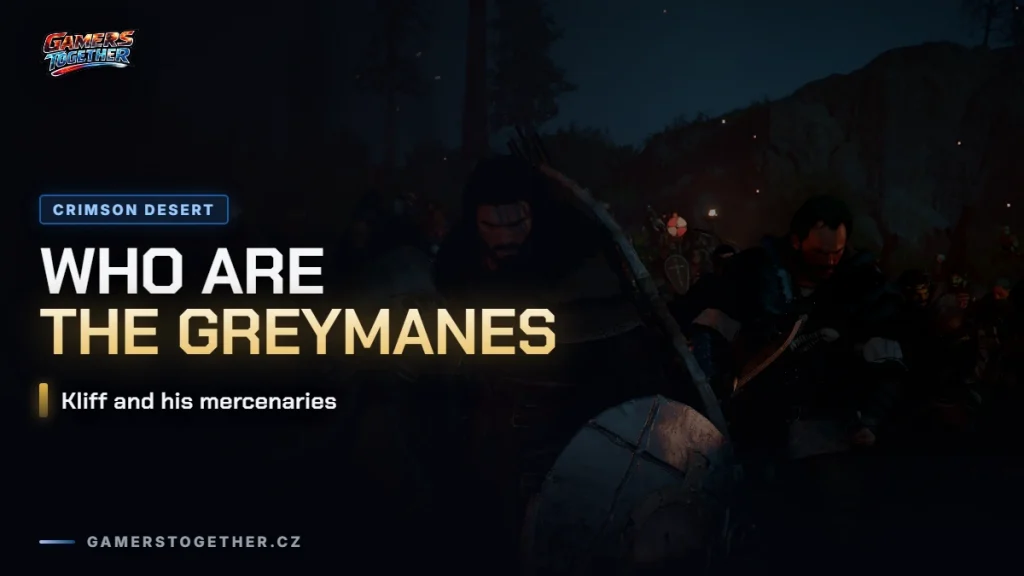
Crimson Desert isn’t a story about a chosen one. You play as Kliff Macduff, leader of the Greymanes, a mercenary company on the verge of falling apart, and most of the game is about keeping those people alive. Your companions are also a mechanic: who you bring along changes what you can do and where you’re allowed to go.
Three playable characters
| Character | Style | When you play as them |
|---|---|---|
| Kliff Macduff | swordplay, heavy shields, battlefield command | the whole game, it’s his story |
| Damiane | dual blades, Abyssal magic, vaulting, stealth | specific chapters and infiltration sections |
| Oongka | brute force and grapples; rips the shield out of an enemy’s hands | chapters where raw strength is the answer |
Base stats carry over between all three, skill points don’t. See the skill order for Damiane.
The Greymanes are a system, not a backdrop
Every member has a history, a personality and a role, and the company management layer turns that into gameplay:
- Loyalty is earned through actions, not money. If you don’t look after the company or you make decisions against their convictions, people leave, or turn against you.
- Bonds are joint finishers. Oongka launches an enemy into the air and Kliff finishes them off mid-air; that’s the clearest example.
- Camp life between missions unlocks Echoes of the Past: playable flashbacks about how the Greymanes came to be and everything they’ve lost.
Who you bring decides where you can go
Pywel is split between hostile factions, and your standing with them changes depending on who’s in your active party. Some companions are outlaws in specific cities: bring them along and you’ll start a brawl or close off a quest line that would otherwise stay open.
That makes choosing your party a real decision, not a stat check. In the open world you usually bring up to three companions, while the whole company joins in for large sieges.
Bonds: why it pays to keep your party close
Bonds aren’t just flashy animations. In practice they’re the fastest way to end a fight that would otherwise drag on:
- They interrupt enemies mid-attack. When an elite opponent winds up, a joint move takes them out before they finish the swing.
- They save Spirit. A companion finisher doesn’t cost your resources, so you still have them for bosses.
- They only work with the right party. Every companion has their own bond, so it pays to bring the one whose move fits your style.
Kliff himself
Kliff isn’t an empty shell. He’s a commander carrying the weight of the people who fell under his command, and the story leans into that instead of turning him into a hero who is above it all. If you’ve finished the campaign and want to take the company all the way, the outpost and war room system in the endgame continues exactly this idea.
FAQ
Story characters have a fixed appearance but changeable gear, armor and weapons. For generic mercenaries recruited in the world, you can also change their combat specialization.
Not necessarily. They can fall in battle (usually they’re only wounded, unless it’s a story moment) and they can leave if your decisions repeatedly clash with their convictions.
Not in the classic sense. The game is built on camaraderie and on the mercenary company being a surrogate family, not on a BioWare-style relationship system.
Up to three in the open world. In large siege missions the whole company can be on the battlefield at once.
No. Switching to them is tied to specific chapters and activities where their abilities are needed. Crimson Desert is Kliff’s story from start to finish.
Information verified as of 7 September 2026. Character roles and the party system have been stable since release. You’ll find more articles in the Crimson Desert section: the siege in the Hidden Fangs quest, regions of Pywel, the fight with the Titan and ten things not to do.